Challenges Associated With Debriefing

I thought I would start the New Year off with sharing some thoughts on some challenges associated with debriefing. These are excerpts from a forthcoming book chapter authored by myself and my collegue Dr. John O’Donnell………..


Challenges with Debriefing

There are a number of challenges associated with debriefing.   Some of them involve self-awareness on the part of the facilitator, the skill of the facilitator as well as resource limitations mentioned earlier.  One of most difficult challenges is the need for the facilitator to be engaged in continuous assessment in order to maintain a safe learning environment for the participants.

Controlling the individual passion focus is an important consideration for facilitators and requires self-awareness in order to avoid bias during debriefing.  As clinical educators from a variety of backgrounds it is normal for a facilitator to have a specific passion point around one or more areas of treatment. This can lead the facilitator to subconsciously pay closer attention to that particular area of treatment during the simulation, and subsequently focus on it during the debriefing. It is particularly important to maintain focus on the simulation exercise learning objectives when they are not designed in alignment with the passion focus of the facilitator. The facilitator must resist the urge to espouse upon their favorite clinical area during the debriefing. Otherwise the learning objectives for the scenario may not be successfully accomplished.

At times during simulation exercises egregious errors may occur that need to be addressed regardless of whether they were part of the learning objectives or not. Typically these errors involve behaviors that would jeopardize patient safety in the clinical setting.  If the topic surrounding the error is not part of the focal learning objectives for the simulation scenario, it is best to make mention of it, have the participants understand what the error was, describe an appropriate safe response and then quickly move on.  Let the participants know that the area or topic in which the error occurred is not the focus of the  simulation but emphasize that it is important that everyone be aware of safety issues.

The maintenance of a safe learning environment is another aspect of facilitator skill development. For example, difficult participants are sometimes encountered, emotionally charged simulations or debriefings occur and students may fail to ‘buy-in’ to the educational method.  All of these situations are under the purview of the facilitator to assist in the process that allows self-discovery and allow freedom on the part of the participants to express their thoughts, concerns, and in particular their decision-making thought processes. The facilitator must always be ready to intervene in a way that attempts to depersonalize the discussion to provide a focus on the best practices that would’ve led to the best care for the patient.

Other factors of maintaining a safe learning environment are typically covered in the orientation to the simulation exercises. Informing participants ahead of time of grading processes, confidentiality factors, the final disposition of any video and audio recordings that may occur during a simulation, will go a long way towards the participant buy in, and comfort level with the simulation process.

Leave a comment

Filed under Uncategorized

WISER Accredited by the Society for Simulation in Healthcare

Image

The Winter Institute for Simulation, Education and Research (WISER) has been granted accreditation in the areas of Teaching, Assessment, Research and Systems Integration from the Society for Simulation (SSH) in Healthcare Council for Simulation Program Accreditation. WISER is the second ever simulation program in the world to achieve recognition in all four accreditation focus areas offered by the SSH program. WISER is the human patient simulation program that serves the education needs of the University of Pittsburgh Schools of Health Sciences and UPMC.

WISER focuses on innovations in healthcare education and research through the incorporation of simulation technology. WISER conducts over one hundred different training programs, many of which with a focus on patient safety. Teaching faculty include physicians, nurses and numerous other healthcare teaching professionals who partner with WISER staff members who have expertise in Simulation based education technologies and curriculum development processes. Participants of WISER programs range from medical, nursing and pharmacy students, through experienced practicing professionals such and physicians, nurses and paramedics.

The SSH accreditation process is a rigorous evaluation that ensures simulation programs are in compliance with or exceeding established best practice standards for simulation center administration, operations, curriculum development, teaching, quality assurance/improvement, governance, patient safety engagement, assessment, and education research standards. The nearly yearlong endeavor included a comprehensive submission package in excess of 2,000 pages, as well as a site visit from reviewers that occurred in early November.

WISER began as a patient safety effort in 1994 focused on operating room safety, and has matured to be a world leader in the implementation of healthcare simulation training, assessment and education research efforts. WISER conducts simulation based faculty development programs throughout the world.

Leave a comment

Filed under Uncategorized

Interservice/Industry Training, Simulation and Education Conference (I/ITSEC)

IItsec2

“The Interservice/Industry Training, Simulation and Education Conference (I/ITSEC) promotes cooperation among the Armed Services, Industry, Academia and various Government agencies in pursuit of improved training and education programs, identification of common training issues and development of multiservice programs.”

It is interesting here at the IITSEC meeting in Orlando to see all the education and simulation technology being de

IItsec1

veloped and used by the nation’s military. There are all types of simulation here from live fire ranges, to handling of mass casualties as well as a myriad of very cool flight simulation equipment as well as serious games of al types. Clearly it has become embedded into the fabric of military training and is regarded as mission critical. We need to continue to make simulation mission critical in healthcare and keep moving the ball dow

n the road. Simulation in healthcare needs to be moved from a ‘nice to have’ to a ‘must have’ through our passion, diligence, scholarly reporting of our work. The healthcare pavilion of the IITSEC meeting is a small but crucial area of the exhibit hall floor. (overall the exhibit space is MASSIVE, and HUGELY FUN! ). I think healthcare being represented here is such a great opportunity for developers and engineers to interact with us, the end users of simIItsec3ulation based education solutions. I think there are many major pieces of the military simulation architecture and engineering that could assist us in the healthcare arena.  Since healthcare is such a major industry in the US alone, hopefully some of the defense contractors will take a look at the healthcare arena with some of their solutions!

Leave a comment

Filed under Uncategorized

Simulation and Medical Student Participation Augment Fidelity in a Resident-As-Teacher Course

Another abstract I just published with two colleagues from the department of emergency medicine. In this project we were evaluating the effectiveness of using live medical students in our course that teaches residents how to be more effective teachers. We use simulation vignettes to allow the residents to practice teaching medical students and then hold a debriefing. In a way the medical students are playing in the role of a “standardized person (SP)”. The residents value the participation of the medical students

Leave a comment

Filed under Uncategorized

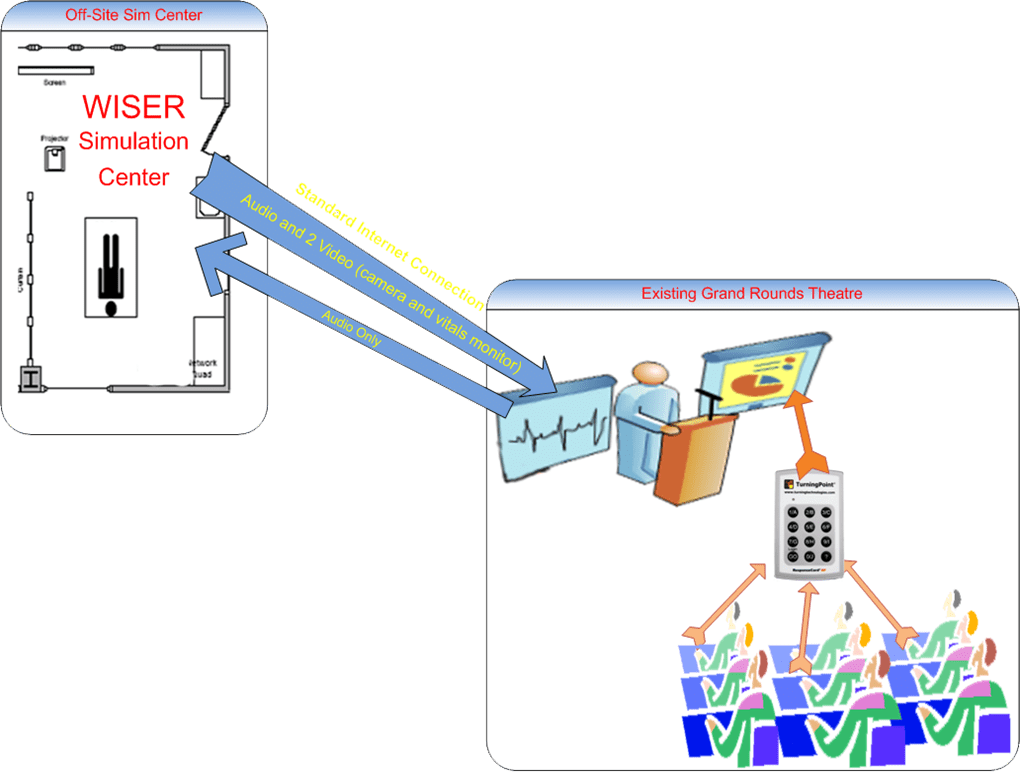
Technology-Assisted Trauma Case Review Conference—Combining Simulation and Audience Response

Just published an abstract on one of our projects with a colleague of mine from Emergency Medicine.

http://www.sciencedirect.com/science/article/pii/S0196064412012681

Leave a comment

Filed under Uncategorized

The Value of Pre-Programmed Scenarios

At most of the programs I visit there is a reluctance to use preprogrammed scenarios with centers opting to run simulators on “on the fly”. While it is true that that there is an investment of time in initially creating scenarios in a preprogrammed mode, I assure you it is well worth the time. I believe you can increase the efficiency and productivity of your center, your ability to function as a facilitator, debriefer as well as run scenarios in a more reliable fashion and gather performance data. (“Reliable” in the sense of running the scenario the same way over and over.) Some people feel overly restricted when they are operating in a preprogrammed mode. People always tell me that students do unexpected things and that is the reason they can’t use preprogrammed scenarios. I will discuss this feeling is likely a result of the way the programming is performed. For the purpose of this post I will be discussing my experiences using the Laerdal SimMan Simulation platform.

Efficiency: When you can train yourself or facilitators in your center to be able to operate simulators on their own and alleviate or reduce the need for a dedicated simulation specialists. Now I know this sounds crazy, but hear me out. I am not suggesting that your facilitators need to learn the nitty gritty about programming and deep technical operations of the simulators. But I have found it reasonable to be able to train new facilitators in a matter of a couple of hours on how to be able to run a preprogramed scenario, collect data and use the simulator output to help script part of the debriefing conversation. I like to use the metaphor of driving a car. We need to be able to teach the facilitators how to “drive the car to the store and back, but NOT expect them to fix the engine, change the oil or perform other technical operations.”

Improve Facilitation: Once you become accustomed to preprogrammed you will worry less about what the simulator is doing and be able to concentrate more on what the participant(s) are doing. Creating menu items allow you to click the progress of the scenario as well as realizing that these “clicks” can serve as notes for you to assist in the debriefing phase can free up a lot of attention and anxiety on the part of the facilitator. The benefits of less stressful facilitation are noted early on, when even the simplest of parameters are preprogrammed to reflect the “initial state” at the beginning of the scenario!

Other aspects of facilitation can be enhanced by the use of preprogrammed scenarios as well. Integrating suggested debriefing commentary, or just listing debriefing suggestions and associating them with menu items can greatly improve the debriefing process. While I’m not suggesting that the entire debriefing can be conducted solely from comments in the simulator log file, the information that is generated by a well preprogrammed scenario can serve as a backbone to help structure the debriefing process. Further, this information is created and collated during the actual running of the scenario, so it is reflective of the actual performance that occurred during the scenario. The other added benefit is the backbone of the debriefing process can help the facilitator stay on track with the intended learning objectives of the simulation encounter as well as lessen the chance that they may miss major points associated with the intended learning or assessment goals. Lastly, it is far easier to teach new facilitators how to run existing scenarios from a pre-programmed perspective as opposed to needed to adjust the simulator on the fly.

With regard to technical reliability, if you think about a simple example of hypoxia, the number of simulator parameters that need to change during the evolution of hypoxia is actually quite complicated. For example we need to elevate the heart rate, elevate the respiratory rate, decrease the saturation, transiently increase the blood pressure, decrease exhaled carbon dioxide, just to name a few. It is virtually impossible to make this number of changes manually, and do it in a fashion that is reliable, which is to say occurs in the exact same sequence and exact same timing every time the scenario runs.

Addressing the programming style of the preprogrammed scenario is one of the most important aspects of success. As I mentioned previously many people feel “trapped” by the idea of running a preprogrammed scenario because often times but dispenses simulations will do unexpected things. I would argue that if your programming style reflects a sequential, expected, flow of activities and/or tasks you are much more likely to end up with this trapped in feeling, during which you assess that the simulator log file does not capture an accurate flow of the scenario as it played out.

A recurring theme of my thoughts in simulation is to remember that we are NOT trying to simulate reality. We’re trying to create an environment that allows people to do things that approximates what happens when they take care of actual patient so that we can form an opinion and give them feedback and help them improve. People make it complicated during the programming of the scenario when the menu items and programmatic flow of the scenario require certain events to happen or not happen. It is important that the programming reflect the possibilities of unexpected things happening, as well as expected things not happening. So separating the idea of the electronic checklist (of items that you want to note, and/or record) and those menu items that are solely existing for the “facilitation” or the driving of the scenario in a direction that allows the educational and/or assessment goals to be accomplished.

Many of the programming courses that are offered by simulation manufacturers encourage programming style that tries to create menu items that follow a scenario with an expected sequential progress. But the reality of simulating healthcare scenarios is there are many correct ways to do things, particularly when you deal with learners above the novice level. To be successful in preprogramming these we must break away from the idea that everything will occur in an orderly fashion. I strongly encourage programming style that assists the facilitator in the electronic checklist items, but also one that helps make it easy for the facilitator to drive the scenario in the proper direction.

The overall center efficiency can be significantly enhanced by the use of preprogrammed scenarios insofar as automating many of the data collection activities that go on in the center. Well programmed scenarios help automate the collection of standardized data with regard to performance, the number of scenarios performed, assistance with instructor evaluations, evaluation of assessments, as well as helping to do quality assurance checks on the scenarios themselves.

In summary, it is true that trying to preprogrammed scenario may seem like more work than running the scenario on the fly. However the initial investment made in a carefully thought out programming methodology can enhance facilitation, debriefing, reliability, and overall simulation program efficiencies.

Let’s hope to get the attention of the simulator manufacturing community to enhance these tools and realize that it will make simulation based encounter more productive. While we need to simplify some of the operations of the simulators, we DO NOT need a dumbing down of the capabilities that enhance the instructional capabilities and resources.

Leave a comment

Filed under Uncategorized

Fidelity vs Technology and Why We Are Doing Simulations In Healthcare

Fidelity Defined by Merriam-Webste a : the quality or state of being faithful  b : accuracy in details : exactness

The concept and definition of fidelity versus technology is one of the most confusing in all of simulation. However the terminology is so commonly used that it seems almost intuitive or easily understood.  The fact of the matter is it’s very complicated by the fact that a given piece of equipment, environment or situation may have aspects of a hint of realism, but we try to use the term fidelity as an umbrella to the entire situation. Often times the word fidelity is misused or improperly substituted for the word technology. I.e. high technology versus high fidelity.  The term technology refers to the level of sophistication that a device contains or utilizes that can be often described in terms of the quantity of electronics, sensing pneumatics, state change capabilities etc.

Remember fidelity is a comparison of exactness, or easier thought of as a comparison to something in the real world of healthcare. There can be many types of fidelity. For example, environmental fidelity, may refer to whether a physical space or situation in a simulation laboratory seems similar to where equivalent patient care may actually take place. Psychological fidelity may refer to whether a given simulation scenario created the same sense in the learner that they may experience when caring for a patient in the real-life. However, it is very common to use the word fidelity to refer to a computerized simulator and therein lies part of the confusion.

Most commonly available high technology, computerized simulators have aspects of fidelity that are realistically comparable to that of caring for real patient, as well as some aspects that are nothing like caring for a real patient. Let’s take a hypothetical example of a simulator called “TeachingMan XL”. When palpating the carotid or radial pulse of TeachingMan XL you believe it is quite realistic when compared to that of a real patient. So the term high fidelity may be applied in the context of palpating the pulse. The same simulator however might have vocal cord anatomy that appears to be somewhat similar, but not very realistic when compared to that of real patient. Particularly if you factor in the assessments of soft tissue pliability compared to that of her real person, moisture, dynamic color changes etc. so in our simulator TeachingMan XL we might say the vocal cord anatomy exhibits medium fidelity.

Now stand back and engage in a conversation with your average computerized simulator. Usually the simulator can respond to you by a series of pre-recorded audio responses, or perhaps someone speaking through a microphone associated with the control panel which is being piped through a speaker in the mannequins head. There is no facial expression or mouth movement when the simulator “converses” with you. This is nothing at all like having a conversation with a real patient therefore we would relate the capability of the simulator to have a conversation as low fidelity. I would worry if we had participants that felt a sense of high fidelity when talking to the plastic man!!!!

 The confusion comes in when people mistakenly use the term fidelity as an umbrella term to describe the simulator. While the simulator described in this essay is clearly high technology, it has aspects of high fidelity (i.e. the pulse palpation) as well as very low fidelity (the ability to carry on conversation). Many people mistaken refer to the simulator as high fidelity, when they really mean high technology.

When trying to adjust for the fidelity of the simulation, it is important to first consider the learning objectives. It is critically important to remember that we are NOT trying to simulate reality. The encounter with any patient, or group of patients is so complex it is virtually impossible to reproduce in its entirety. Nor would we want to. We are conducting simulation scenarios to create an environment that allows people to suspend their disbelief and engage in the care as if they were functioning in the real clinical practice environment. We want this to occur so that we can form an opinion, deliver feedback, and lead the participant(s) to engage in active reflection via a debriefing encounter to allow them to improve as healthcare providers. Thus the purpose of the simulation is to accomplish the learning and assessment objectives, not to simulate reality.

There are varying degrees of things that we can adjust to change the fidelity. Many of the decisions in simulation scenario design are often predicated upon equipment availability, the complexity of the setup, the complexity of the cleanup, as well as the overall time investment made by the participants as well as the facilitators. The key to designing a successful simulation scenario is to make sure there is a continued focus on the educational outcome of the scenario and not to become enamored by the technological capabilities, possibilities of the simulation equipment, environment or environmental manipulators such as complicated moulage or other theatrical engagement.   Provide just enough fidelity, but don’t overdo it!

So in closing, I would encourage you to stop and think the next time you use the phrase High Fidelity, to consider if that is what you really meant!

Leave a comment

Filed under Uncategorized

Technology in Education Essay

A great read for simulationists!

Technology, learning, and free will


Leave a comment

Filed under Uncategorized

Geetings Colleagues

I am setting up this site as a resource for sharing my thoughts, observations and resources that I come across regarding healthcare simulation. I hope to hear comments from you as we move along this journey to improve patient safety, help healthcare providers learn more, demonstrate their knowledge and enagage in a powerfully immersive learning experiences that we create with the simulation environment. – Paul Phrampus

Leave a comment

Filed under Uncategorized