Tag Archives: simulation

Insitu Mock Codes Evaluate People Readiness and System Readiness – An Important Patient Safety Tool

CombinedTeamandEvaluationOver the last 20 years WISER has conducted hundreds of unannounced mock code evaluations at hospitals directly associated with our health system. Additionally we have assisted others with conducting and reporting on this important patient safety activity in hospitals both in the US and outside. As it is true in most things in simulation there is no binary answer on right versus wrong in the way simulation is carried out.

In situ mock codes bring a unique perspective that allows all of the effectiveness of simulation based education to be combined with human factors and systems testing that are crucial to ensure higher levels of patient safety for the increasingly ill patients who are being cared for in hospitals around the world. This is a patient population that is at well documented great risk for harm from errors that occur resulting from a myriad of causes ranging from human error to poorly design systems.

Mock codes in hospitals bring crucial insight into the care delivery that occurs episodically in high tempo, high stress unplanned situations in our hospitals. They can identify areas of deficiency that are not readily apparent. (Simulation of in-hospital pediatric medical emergencies and cardiopulmonary arrests: highlighting the importance of the first 5 minutes; Hunt et al. Pediatrics. 121(1):e34-43, 2008). We can gain unique perspectives such as where do we need to place AED’s? Is the hospital operator handling code requests in the most expedient fashion? Where in the hospital should responders respond from? It is these important system data points that can be understood from mock code data generation that are impossible to gain conclusive evidence from in the simulation lab, or in those mock codes that personnel know are of the simulated variety.

While we are able to do undeniable powerfully effective training in our simulation labs, it is the mock code and other insitu activities that help to bring true facts to factor into decisions that evaluate and ultimately improve patient safety. Do mock codes have the ability to lead to unintended harm or further error if not carefully planned carried out and monitored? Of course they do, and they must be regarded as such. But mopping the floor of the hospital also carries forth the increased possibility of hip fractures, yet it is a required element of infection control and with appropriate precautions and guidelines we make every attempt to minimize this potential risk.

Those of us in healthcare who are directly involved in the care of patients as well as those who have roles in system oversight of the direct care of patients recognize that with every intervention, every therapy and every procedure there are risks and benefits. The same goes for the training we provide. The fact that someone in a simulation center may get shocked by a defibrillator or stuck by a needle during simulation training are potential harms that may occur secondary to the use of simulation based education. So we recognize these risks through failure mode effect analysis, learning from others at meetings such as the International Meeting for Simulation in Healthcare (IMSH), remaining informed by current literature and implementing solutions that attempt to minimize these risks.

While Raemer does a wonderful job of pointing out some of the potential possibilities of potential hazards associated with mock codes (Ignaz Semmelweis Redux?; Sim Healthcare 9:153-155, 2014), this personal opinion piece does not actually include an overall analysis of risk vs. benefit. Nor does he present any data that combines evaluation of training programs, professional readiness and systems design with a quantitative deliverable that allows such an assessment. With the latter information properly collected and analyzed those of us involved in designing future care delivery systems through policy, investments in training, staffing and equipment will be better prepared to make a difference in the safety of patients.

The reference to the Owen article is baffling. (Unexpected Consequences of Simulator Use in Medical Education: A Cautionary Tale; Sim Healthcare 9:149-152, 2014). Professor Owen authored a remarkably elegant piece in this month’s SIH journal that was inappropriately titled in my opinion. The title seems to be one that attempts to be provocative in an ability to gain ones attention in the simulation world.  (That part was effective I must admit, as I read the article immediately.) However the article and its title implies that the use of simulation CAUSED untoward outcomes in patients. From a root cause perspective in the information presented in the article, that is NOT THE CASE. The poor outcomes were associated with the lack of hand hygiene and the lack of knowledge associated with proper hand cleaning and infection transmission. It is analogous to saying that an automobile striking a pedestrian is the fault of the car.

I would estimate real codes occur in our healthcare system (of 20 hospitals/care facilities) roughly 50 times per day. So if we simply take 50 codes per day that is 18,250 codes per year. This is not a rare critical event; this is a common critical event that we still have much to learn about from a training perspective as well as a systems design perspective. We all know there are delays and errors associated with codes in general. My colleagues and I reported an enormous amount of medication administration errors during observations of REAL CODES (Medication errors during medical emergencies in a large, tertiary care, academic medical center; Resuscitation. 83(4):482-7, 2012 Apr) and that is just one element in the complex environment of actual codes.

Despite reams of paper trails, and gigabytes of data in the vaults of patient safety and risk management reports in the offices of hospitals, we still have very little insight into the actual root causes of the epidemic of harm to patients that occurs during hospitalization. The mock code, with its associated risks and POTENTIAL complications is an important tool in the armamentarium of patient safety probes that will ultimately save lives.


1 Comment

Filed under Uncategorized

Simulation: It’s Not All About Teamwork

healthcareTeam_shutterstock_71658691_a

Competent Professionals. That’s the thing that ALL health care teams are made of!

Those of us involved in simulation know that it is a powerfully, wonderful tool for educating and assessing people with regard to teamwork skills, responsibilities and communications. However that does not mean that every implementation of simulation needs to involve teamwork and communication skills.  Since the famous Institute of Medicine report came out in 1999 citing critical deficiencies in teamwork in healthcare environment and how they can be attributed to medical errors and less than quality patient care, as well as a recommendation for simulation to fill some of these gaps, many people have taken it as a mandate that simulation MUST include team training and communications. I say, Not the case.

In fact, I would argue it’s detrimental to think that way. Teams are built upon the pillars and shoulders of competent healthcare professionals. There are still gaps in educational needs in the ability to more efficiently educate individual healthcare providers, as well as provide assessment into their overall competence based on where they are in the spectrum of entry-level student to practicing clinician. While I would certainly advocate for teamwork and communication skills to be incorporated into any healthcare curriculum from beginning to end, I think there are plenty of appropriate times to ensure there is a mastery of individual competence in those goals and objectives that are surrounding knowledge, skills critical thinking and attitudes that we expect a competent professional to bring to a team.

The design and execution of the innovative education programs involving simulation has many different variables when we consider the needs of that of ensuring individual or personal confidence, versus that of a team. In fact the learning objectives would look quite different if we compare evaluating that of the responsibility of an individual person providing care, to that of the skill set that person should develop to be an integral part of the healthcare team, as further compared to the skill set that we would expect a team of professionals to demonstrate when involved in the care of the patient(s).

The detrimental part that I speak of I see far too commonly in my travels and observations of simulation efforts. There are many times when simulations are conducted that are largely designed to educate, and/or assess aspects those objectives that are largely individual in nature, such as decision-making, analysis, or perhaps psychomotor motor skills. Then at the last minute there is a design decision to include more students and literally “throw in” some elements of teamwork and her communications into the design of the scenario that ends up not being well thought out.

The end result is not hard to predict. Such simulations usually produce less than desired outcomes with regard to ensuring individual competence improvement, and are often confusing and/or inefficient with regard to being able to impart the skills associated with teamwork and communications.

So I do think that teamwork and communications, as well as team leadership skills are an important set of competencies that we need to continuously teach and evaluate across the spectrum of healthcare education and believe that simulation is one of many excellent tools to accomplish this.

However, I advocate that you proceed carefully with a well vetted list of objectives that lead to adequate scenario and curriculum design. I think you should carefully determine whether your overall educational effort is best suited for the competency of an individual, or is it largely directed towards focusing on teamwork and interpersonal communication efficiencies and effectiveness.

I do believe we can design encounters that effectively involve elements of both, but not without careful planning and forethought. In such attempts there is always a natural tension between those elements of design detail and assessment that can be applied to individual competence and those that can be applied to the team components.

Attention to these details will assist you in creating more robust educational encounters for your learners. It will also afford you better outcomes for your overall investment of time and money into your education program.

Leave a comment

Filed under Uncategorized

Simulation Can Be the Model Flipped Classroom

FlippedClassroomSimulation can be utilized in a manner that is consistent with the current recognition of the gains and benefits of “The Flipped Classroom”. Essentially the flipped classroom that many educators are talking so much about is an engagement of the students that is different than traditional models. Historically learner show up to lectures to learn about a new topic and then are assigned homework to reinforce the concepts. In the model of the flipped classroom, the students are provided with tools such as lectures, video examples, resources, reading lists that introduce the topic and allow a cognitive exploration BEFORE coming to class. Then they show up to the face-to-face activity and instead of hearing a lecture from the professor are engaged in higher levels of cognitive processing regarding the topic. These higher levels could be conducting experiments, experiential learning, exploration, group discussions debating a topic, or perhaps engaging in scholarly debate on the merits.

Imagine education surrounding a topic that involves pre-learning such as web-based education, video reviews, or other activities that either introduce a new topic or perhaps refresh the cognitive underpinnings of the subject matter. Then have the learners come together in a face-to-face environment and engage in experiential learning through simulation of various sorts that may include mannequin based simulation, partial task training workshops or content review discussions. It seems like the ultimate combination.

Interestingly, as I have been reading more about the Flipped Classroom I realize that we have been utilizing these concepts for many years in Simulation in particular with our programs aimed at training residents and practicing professionals. At my center (WISER) many of our courses are created with just that type of overall education strategy. Our Simulation Information Management System (SIMS) houses over 125 courses many which have extensive online materials for subject matter review prior to the actual simulation day. Subject materials may be pre-recorded lectures, PowerPoints, screen based simulations, videos demonstrating correct performance for example. Some courses even perform pre-tests before the actual simulation encounter to ensure that the cognitive preparation has been completed.

Intuitively it is easy to understand the advantages. The face-to-face time that students spend together in conjunction with faculty members is generally the most expensive time of the education. So it seems that we should be creating activities that maximize the effectiveness of the precious face-to-face time. Now the technology is no longer a barrier for the dissemination of information we can appeal to various learner types and styles, as well as keep the face-to-face time for much higher-levels of engagement. Thinking about it from a Kirkpatrick model we can move the reaction and learning levels to a more efficient off-site, self-paced exploration and learning, and then maximize the time the face-to-face environment with faculty to achieve higher levels of knowledge acquisition and expertise such as behaviors and results.

Image

Kirkpatrick Model of Training Evaluation

During the learning and reaction phases the learners can obtain the materials at their own pace and perhaps have a choice of methods by which to achieve the cognitive learning objectives. This increases the efficiency as learners who are mastering the material more quickly can move along to more advanced topics, and those who need a little more time, or need to review several times over have the ability to do so.

During the face to face sessions simulations scenarios can provide a deeply immersive learning environment for learners, and then this can be augmented by rich interactive discussion with faculty members as well as peers as continual mastery of the materials are recognized. The experiential learning offered by simulation can help to demonstrate the student’s mastery of the material from a cognitive perspective as well as demonstrate the ability to apply to real-world or near real world settings and circumstances.

This combination of cognitive priming or preparation with the experiential immersive process seems right to apply to the healthcare education environment. Recognizing that simulation, mannequin based simulation in particular, can be an expensive time-consuming endeavor; we need to ensure that we are maximizing the overall outcome of the educational experience.

Thus I argue simulation can be the Model Flipped Classroom and provide significant return on investment for topics that are appropriately bundled in the fashion described.

4 Comments

Filed under Uncategorized

Running Scenarios “On-the-Fly” is Like Typing PowerPoint Slides in Front of a Live Audience

Print

Could you imagine sitting at a lecture at a meeting and the presenter was typing the information to create the slides while theydelivered the lecture? I believe it would be maddening, particularly if the person didn’t type very well!  Well folks, that is akin to what you are doing when you run your SimMan scenarios “on the fly”. Actually it is likely worse. I am writing this post in the context of SimMan because that is the system of which I have the most hands on expertise, but this story applies to almost all of the commonly available computerized patient simulators available at the present time.

Begin by asking your self, why do I create a PowerPoint to use during my presentation ahead of time, instead of in front of an audience? The answer is because you want to pre-populate, or preprogram frames of information grouped together to help your audience understand what is going on. The information that you are likely pre-populating your slides with is likely to complex, or at least too cumbersome to type out in front of the audience. In addition, you likely save your PowerPoint presentation so you can use it again and deliver the same or similar presentation with some consistency, I would ask you to realize, that this same thought process could be applied to the preprogramming of the simulator presentation during a scenario.

When you use a computerized simulator during a scenario, you are asking the participant to look at the frames of information that you are presenting to them. The individual vital signs, perhaps a sound or some other visual aid may all be part of what you want them to see. They begin to interpret your story usually in the context of a clinical situation requiring their interpretation, analysis and treatment or decisions.

As you allow the story to evolve in response to their actions or inactions, the simulator may changes states. For instance, in response to a proper treatment, you may want the vital signs to improve. Think of this as when you want to tell something different in your presentation you witch to another PowerPoint slide. Why? Because you want to present the next frame of information to the audience.SimMan

No matter where I travel in the world there is a common theme that I hear regarding SimMan scenarios. That is to say that people say “we tried programming and that didn’t work, so now we do run them on the fly.” When I ask for more details the story is usually the same. Participants always do things that we aren’t expecting and we need to “take over” is a common response. There is a feeling that when you are in a preprogrammed scenario as a simulator operator that you are trapped. Guess what? This feeling may be valid depending on the style of programming that is employed.

Also think of it from a different angle, one of my previous blog post points out the complexity of vitals sign changes that need to change during a course of worsening hypoxia. I argue that it is essentially impossible to change everything in the same way every time a scenario is run. So in essence, you lose the ability to generate consistency in running your scenarios. This consistency, or reliability is important to achieve when using scenarios as assessments.

What is the problem? The Trainees? The Operator? The Software? The Programmer? I would submit that the software systems that accompany most patient simulator these days are quite sophisticated with very deep capabilities. Most of us only learn them superficially at best. Further, those who take classes usually learn from a representative of the company who sold the equipment and there style of programming often doesn’t match reality.

Well the first lessen is participants ALWAYS do something unexpected, or at least almost always. So therefore if your scenario programming STYLE boxes you into a corner when the unexpected happens, you should change your ways, not abandon the work!

One of the best ways to get started with a comfort zone of using programmed scenarios is to use the software to create your initial set of vitals. If you think about it, just setting vitals alone causes a significant amount of task loading at the beginning of the scenario. If a patient is in shock, you would likely at a minimum, change the heart rate, pulse rate, resp rate, oxygen sats, End tidal CO2 and on and on. All of this if of course depending on the complexity and depth of clinical information you are trying to control for a given scenario.

I think of the example above every time I get to drive my wife’s car. I sit in the drivers seat and push a button labeled ‘[Driver] 2’. When I do this, the seat moves, backwards, reclines slightly, the steering wheel moves away from me and down a bit, and the mirrors adjust to where I had them previously. Brilliant! Pushing one button set so many things that I may have to adjust manually. This saves time and ensures a consistency in my experience when driving her car.

The properly pre-programmed scenario offers you quick set up (like my wife’s car), flexibility, consistency in presentation, ways to deal with unexpected, and maybe most importantly, helps allow you to observe the scenario more closely and worry about the simulator less.

This can be accomplished through an increased understanding of what the software can do, and a realistic application to your scenario objectives. Start by unlinking your changes in the vital signs or condition changes to the events playing out in front of you. Create menu items that have the simulator presentation get worse or get better, that you can trigger based on what you think should be happening based on the action or inactions of the participant(s).

Think about taking some small steps into embracing the pre-programmed scenario into your armamentarium of simulation tools. Do yourself a favor and take a simulator programming course from someone who is not a hardware company rep. Done properly, I promise you it will expand your capabilities as a simulation educator. It will also allow more flexibility in your scenario designs and increase the consistency when you run a given scenario.

Lastly, changes in the simulator condition is just part of the power of the software that you already own if you have a Laerdal Simulator. There is so much more to talk about in trying to convince you of the power that lurks inside your SimMan! I haven’t even begin to cover other technological assistance that can help with debriefing accuracy, structure and consistency, automating data collection and on and so much more!

With just a small investment in time and perhaps an adjustment to style, you can significantly boost the productivity of your Simulation program.  So fear no more, take the deep dive and learn more………

5 Comments

Filed under Uncategorized

Assess-a-Phobia In Simulation – What Do We Tell the Patients?

shutterstock_119870338We need to end the terror at the thought of using simulation for assessment. I am of the opinion that one of many significant returns on investment to the healthcare community for simulation is in our ability to develop tools to help objectively assess performance. Healthcare education has evolved with a strong reliance on the knowledge base test, those that assess one’s cognitive knowledge. There is little doubt that no matter what profession in healthcare one practices a high degree of cognitive knowledge and intellectual competence are both necessary.

However, in healthcare it is important that one can apply the knowledge given the contextual circumstances they are faced to deal with when caring for patients.  Simulation is evolving as an excellent tool to help provide some insight into one’s performance competence. In other words it gives us another vantage point to understand if one can actually practice and put into good use the intellectual capital that resides in their brain that was acquired through various methods of educ ation as well as experience.

Having been an educator for well over 25 years I have conducted my share of assessments. Admittedly, most of them are cognitive tests, i.e. written tests to do some sort of knowledge base shutterstock_89679427assessment. In fact, I bet most people reading this have developed some sort of written test assessment that they have given to students sometime in their career as an educator. We think nothing of creating a written test, dealing it out to a room full of students and assessing them on their ability to pass the test by whatever bar we have set as a passing score. Typically a written test has many, many items to account for the fact that variability in the testing process, variability in the interpretation of a question, as well as the fact that one not knowing a single fact should not contribute to a pass or fail on its own.

Depending on the level of stakes of the exam, we will apply more and less rigor in trying to statistically validate each item, or the test overall. Over time we become confident in our written testing instruments and use them over and over again. Eventually, we develop the confidence to say someone actually passes or fails. This can be high-stakes such as passing or failing a course, passing or failing an examination of competence that may lead to certification or other such examples.

I believe some aspects of simulation have evolved to be just as good as that bubble sheet in one’s assessment. In fact I suppose that’s not even a fair comparison because the bubble sheet is going to assess something different than the simulation. Why of course there might be overlap in what we are assessing with these two instruments but they are different tools indeed. The bubble sheet is going to best be assessing cognitive knowledge, and the simulation can be engineered to assess application of knowledge into practice.

shutterstock_85476502There is a reluctance amongst many to engage in simulation assessment activities and I am not sure why. If we think about the analogy to the written test I described above, we feel really comfortable going into a room by our self or with several of our colleagues in creating a multiple-choice written test. Why is it that we cannot go into a room with a number of our colleagues and develop some sort of assessment for simulation environment and capitalize on the advantage of the ability to observe one’s application of knowledge as described above? Continuing with the same analogy, we can then collect data over time and compare the individual items that were assessed, or the ability of the test as a whole for validity.

The origin of this reluctance is complex. In fact, the whole notion of performance assessment of humans is quite complex. However, we should not run from things because they’re complex. I think another part of the reluctance is it is a challenge to our own comfort zone. Arguably it is more difficult to give direct feedback and let someone know that they did something incorrectly, unsafe or otherwise in a face-to-face discussion as compared to letting them go to the wall where their grades are posted and see that they failed the written exam. Another piece is it takes a lot of work to design such assessment tools. But again, the mission is so critically important can’t run from the hard work.

Another part of the reluctance comes in the fact that very few of us were actually trained in the creation of human performance examinations. However if you think that through, very few of us were formally trained in the science of creating written test examinations either. Yet the comfort factor with the latter allows it to happen much more routinely.

Another way to think about it is, if you are a clinician that is supervising a trainee doing a potentially dangerous procedure on a patient is your job to give them feedback that will allow them to improve in the future. Likely some of this conversation will be reinforcing the things that were done appropriately while other aspects of the conversation will require them to make changes for the future for the things that they did improperly. So in essence, you have created an assessment!

Some will read this and argue that assessment violates the principles of a safe learning environment. I fall back on the topic of one of my previous posts, and say that we need to concentrate on Patient Centered Simulation. Likely those who argue that point are not on the front lines of healthcare and understand the need for near-perfect performance in everything we do as we do things for and to patients. Nothing is quite as disconcerting as seeing a trainee make a mistake on actual patient that has a high potential, or actually causes harm. Do we then turn to the patient or the family and say, “I’m sorry, we had the ability to assess their competency in the placement of a central line, but we thought we shouldn’t do that because it wouldn’t represent a safe learning environment.”? Seriously? I think not!!!!!

Simulation has what is so far a largely untapped capacity and capability to assist us in the journey that will make an assessment pathway to help assess competence in the newly acquired skills and critical thought process, as well as evaluation of the maintenance of proficiency and currency of knowledge, as well as application of knowledge over time.

I truly believe that it is the assessment component that will help bring the demands of simulation to the next level. It can be an important tool in the migration from time-based objectives, to a more rational system of performance-based objectives when considering things such as acquisition of practice competence, advancement in training, or even the measurement of competency in the maintenance of practice over time.

Leave a comment

Filed under Uncategorized

Suspension of Disbelief is So Yesterday – Lets Think About a Great Movie Encounter

The concept of “suspension of disbelief” was orginally attirubuted to a poet/philospher in the 1800’s with regard to creating works of fiction to be interpreted by readers. When I first started in healthcare simulation back in 1997 it was told to me that we needed to create an environment where there is a suspension ofdisbelief so that the participants will believe that they are in the actual health care environment and perform accordingly. I drank the coolaid, I thought that is what we were to do. Today when I reflect on this notion it seems a bit crazy when it is inerpreted to mean that we are designing simulations to make participants forget they are in the simulated environment.

Certainly we don’t want health care professionals to actually think they are in the real clinical environment when they engage in simulation.  We want to create an evironment where they can perform aspects of what they do when they are taking care of real patients so that we can form an opinion to help them improve. This ocurrs through feedback,  assessment and debriefing methods as well as other innovative learning and assessment strategies.  I think we need to think of it more as a “fiction contract” which I believe was a term coined by Peter Dieckmann of Copenhagen which has always resonated with me. (At least he was the first person i heard use it in that concept, shutterstock_130674926and he a brilliant mind in simulation as well as a friend.  So barring any information to the contrary, i’ll leave it attributed to him for the time being 🙂 )

A good metaphor would be to think of it more like the intellectual engagement of going to see a great movie. The movie goer buys a ticket and enters into a contract (of sorts) with the producers of the film and perhaps the movie theater involving a belief  that the money they are spending will allow them to see something that is not quite real, but is a reenactment of something real, and  perhaps they will be participating in it emotionally and psycologically, but they never thought it was real.  However, the value to the participant is in the movie metaphor would be the entertainment provision.  So in essence the “deal” is summarized by the fact that they are entering into an unofficial agreement that says I will provide you $15 to buy the movie ticket, and you will provide me two hours of entertainment. 

I think there are strong analogies between that and the way we should approach healthcare simulation relationship between participants and the simulation providers. We need to create environments where the participants trust us so that they will engage psycologically and emotionally in the simulated environment  in exchange for the valuable use of their time to help them improve as a healthcare provider. 

I think that if we shift the focus so that we are not trying to create a “suspension of disbelief”, it will allow us to better create the environment necessary for effective healthcare simulation. That is that we realize we’re not trying to recreate everything to do with reality in healthcare, we’re just trying to recreate that which allows the participant to engage in a way that they might when they are actually taking care of patients. I think it is particularly important to be direct in letting the participant know that not everything we do in simulation will mimic their realistic practice environment. If we are honest with this orientation and apporach, I believe it causes less constrenation on the part of the participant who is in an environment where some things seem real and some things do not.

Participants are often experiencing a sense of  internal “conflict” when interpreting what the see, hear and experience in the simulation, wondering is this supposed to be part of the simulation or not? I am of the opinion that they are more likely to reconcile this with us if we are frank, open and honest about the intent and expectations of the simulation. This is in contrast to simply asking them to “pretend this is all real” conceptually describing the mantra of suspension of disbelief.

Through this bilateral agreement we enter into a fiction contract or a trust contract that says, on the participant’s side, I will engage in this activity in exchage for the trust that you are making valuable use of my time and helping me become a better healthcare professional.  On the simulation provider side of the agreement it goes something like this: “we will create an educational program using aspects of simulation, which some parts will feel realistic and some will not, but we commit to you that this will be a valuable use of your time with tust, dignity, respect and professionalism. We will attempt to help you get better as a healthcare provider.”  Isn’t that what we’re all trying to accomplish? To me this seems more plausible than asking professionals to suspend the disbelief and interpret the entire simulation as “real”………

Leave a comment

Filed under Uncategorized

Simulation and the Future of Customized Continuing Education for Practicing Professionals

Click Here to Watch the Video on YouTube

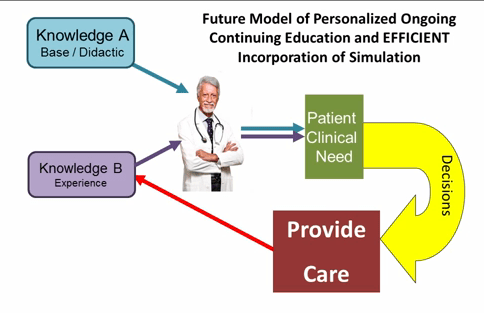
I posted a new video on the WISER You Tube channel describing how simulation can fit into a futuristic model of customizing a pathway of continuing education for practicing healthcare professionals. The model incorporates the utilization of healthcare system quality, safety and risk data. A provocative thought to move us down a road to help imoprove replace the time honored, yet inefficient system of continuing education that exists currently.

SimandContEd

Leave a comment

November 13, 2013 · 7:50 pm

Patient Centered Debriefing – The Ultimate Goal

I am growing more and more concerned about the pacifism by which I hear people approaching their debriefing efforts as I travel about the world. The phrase “safe learning environment” is being hijacked into some sort of process during which the only thing that matters in the world is the feelings of the learners participating in the simulations. So much so that some are saying you shouldn’t tell students what they didn’t do correctly and that during debriefing you should only focus on that which went well and then have a group hug at the end. This is being claimed under banners of student centric debriefing, “safe learning environments”.


Do these same educators harbor the fear and trepidation that students might be sad if they perform poorly on a written test? Do these same educators realize what a disservice they are doing for the students when you step back and look at the big picture?  Maybe the educators themselves have a tough time bucking up and delivering the news, doing the HARD WORK of simulation. Perhaps, this shifting or trending is partly evolving because many of the people involved in the teaching and theorizing about simulation feedback don’t see patients on the frontline of the healthcare battlefield.


I am certainly not advocating that we don’t need to be mindful of students emotions and psychological well being during simulation education activities, but come on people, healthcare decisions and actions involving patient care need to be near perfect. Every Time.  We need to be certain that when participants leave our simulations they have a clear understanding of what was right and what was wrong not just do a deep dive into their feelings carefully guarded by the emotions police and find happy things to chat about.


I am sorry to be the bearer of bad news, but providing healthcare is hard work, stressful and requires excellence. We need to develop/reinforce excellence in the participants of our simulations and help them achieve their goal, which is to get better at what they do. Every healthcare professional in the world has this as a goal at some level. How we reach out to them and help them along this journey needs to be PATIENT CENTRIC because the ultimate goal is to continuously improve healthcare throughout the world.


We certainly must develop methods consistent with the levels and abilities of our simulation participants and create environments that are open to participating, learning, exploring and discussion. But we also must provide participants with information on where they are with regards to expected performance on a continuum of the development of competence. We can not hide the truth during a debriefing because the faculty is uncomfortable with delivering critical feedback, or is so concerned that the students emotional fragility will be violated if they receive the feedback. This is a violation of our ultimate relationship with the ultimate beneficiary of healthcare simulation, the patient.


During debriefings it is incumbent upon us to make sure that students are treated fairly, treat each other fairly and help to discover things needed for improvement through creating reflections on the learning activities. We also need to make sure there is crystal clarity on expected outcomes versus perceptions of performance that are reconciled. We also must guide the debriefing process in a way that is mindful of the psychological safety of the involved. I think this can be done with adequate training, re-training and continuing practice with the art of debriefing. When we achieve this, we have arrived at Patient Centered Debriefing, and that’s a place I think we all want be.


I do believe most professionals want to know what they did well as well as what they didn’t. They are the fundamental elements of being able to reflect and improve. We need to be able to have the message delivered by either a process of self-discovery, perhaps through facilitated reflection, or at other times, but just directly providing the information. This doesn’t mean it has to be harsh, or without the feelings of the person involved carefully considered, but it does mean it has to happen with a level of deliberateness that is unequivocal. It is the true art of the debriefing to be able to lead this effort and achieve these goals.


Finally I’ll close with a quote from my twelve-year-old son about one of his baseball coaches, “Dad, why does coach always tell me I did a good job when I know I messed up?” What is the answer? Not sure, but I hope that the coach doesn’t change careers and become a simulation facilitator for healthcare professionals.


6 Comments

Filed under Uncategorized

Let’s stop using the ‘F’ word in Simulation

Image

When it comes to simulation speak it can get very confusing now days. But all in all we can agree that the word simulation in the healthcare sense relates to the substitution of something (ie situation, environment, equipment, people, etc.) that we can use to teach and/or assess someone, or some group of people to improve their knowledge and or performance in the patient care environment or a related system. Even as I compose this definition to try and encompass the common forms of simulation I struggle a bit, but feel that I covered the gist of it.

That being said the ‘F’ word in the context of simulation is one of the most overly and misused terms that gets bantered about on the regular basis and introduces not only confusion, but subtle thoughts of “the right way” and the “wrong way” to approach simulation. That word of course is fidelity. Likely coined by industry or the inventors of something or some system that approximates part of a human beings anatomy or a specific environment. I argue here that to properly use the term fidelity we have to define it in context with a rather specific focus and would rather we just eliminate it from our vocabulary.

Recently I was touring a simulation center and was told, “We do our high fidelity simulations in these rooms”. The rooms contained high technology human simulators with no other specific environmental attributes except an overly populated array of video and audio capturing devices. We travelled down the hall and my host told me “We do our low fidelity simulations like task training and SP’s in here.”  This notion was an immediate hair rising response for me representing a gross misuse of the term. Seriously? If fidelity is that by which there is some measure of realness, then how can one ever describe an SP as low fidelity?

Conversely when I touch the pulse of, or perform a needle decompression on a SimMan®  I can appreciate a comparison to those events in real patients, thus suggesting an increased realness or dare I say, fidelity. However take that same simulator in a room and have a conversation with it for 20 minutes and then tell me it was a high fidelity experience? Examine the knee joint of a METI HPS and tell me that you every felt a knee like that on a real patient? I think not. So are these machines both high fidelity and low fidelity? Or is it something in between? I think if it labeled a high technology piece of equipment there would be little argument. But, high fidelity? Seriously? Perhaps in some very focal aspects, but I would argue certainly not in total. Thus the confusion begins. Does it matter?

While the above example focuses on a simulator, the same analogy can be made when we talk about the environment the simulation is conducted in. If the simulation takes place in a room that is decorated or equipped to mimic an actual operating room, the situation may appear highly realistic when compared to live surgery and therefore might be labeled as high fidelity. But we must bear in mind that the reference to fidelity in that sense is to the environment. If we are running a scenario in a highly realistic replica of an operating room with a low technology simulator, is that called high fidelity simulation? If we ran the exact same scenario in the confines of a hotel conference room and were able to accomplish the learning objective, is that lesser fidelity? Does it matter? What is we ran a scenario in a beautifully equipped simulated operating room and didn’t accomplish the learning objectives? Is that still high fidelity?

The same type of descriptive dissection can be used to describe the people involved in a given scenario. If a standardized patient is rendering a convincing performance of crying during a scenario focusing on delivering bad news, what do you call that? Incidentally, I have never been to a theatre production and walked away thinking that was a high fidelity production even though there are elements of the every stage production that may seem realistic and those elements that are clearly not!

The same type of comparative discussions could be used to evaluate the realness of the audio cues, the equipment racks used, the amount of stress caused by the simulation and on and on as compared to life in the real healthcare environment. The bottom line is there are always elements of every scenario that seem very close to reality and those that don’t. The decision by which to include and exclude various elements is complex. Many variables factor in including, budget, resources of equipment, people and environments, and hopefully most importantly consideration for the ability of the scenario to accomplish the learning objectives in the most efficient and effective way possible. After all isn’t that what we are really trying to accomplish?

Thus if you must continue to use the ‘F’ word, please, please, at least apply the context by which you are using it. We even have the editors of healthcare scientific journals confused and believing it means something such as a standard! Talk about confusion? I believe much of this comes from industry terminology evolving from sales speak, as well the creeping danger of the simulation being the focus of the activity. The education and/or assessment outcomes must always be the focus of the activity.

Lets all agree to do high effectiveness simulation and therefore truly think about the outcomes we are trying to achieve as opposed to the show we will put on along the way!

1 Comment

Filed under Uncategorized

Purpose of Simulation Isn’t to Mirror Reality

Image

The purpose of clinical simulation healthcare is not to mirror reality. The primary objective of the most commonly used simulation is to improve the performance of humans as it relates to caring for patients within the context of healthcare. Too many times we get lost in toiling over the details of trying to re-create a scenario as realistic as possible. This often leads to what I describe as invisible barriers to simulation insofar as design, perceived resource limitations, or operational realities limit the bandwidth that the simulation program is able to accomplish. It’s important to remember that the primary objective is not to simulate, but to educate. (Certain exceptions may apply to research projects, and human factors design elements, or other factors studying mimicking existing process flow etc.)

When we run a simulation we are not trying to convince the participant that it is real (because if they did think it was real they would likely be a little crazy J). What we need to do is create an environment that helps the participant feel as if there is some realistic comparison to the simulation to what they do when they are actually caring for patients. We need to enter into what is frequently referred to as a fictional contract or psychological contract that allows the participants to drop into their role as a normal care provider knowing that the simulation is artificial, but has value to their learning and their future practice.

Many, many decisions go into the design of simulation. Often times the specifics of the learning objectives and outcomes do not receive as much attention in the design phase as some of the other elements to try to create “perfect fidelity”.  In doing so we often unnecessarily add to the complexity of the scenario that may increase the setup time, the cleanup time, expose the scenario to the potential of technical failure. Further, we can actually confuse the participant as during the scenario they are constantly trying to assess what they are supposed to be interpreting as “real” versus that which is simulated.

So the next time you’re designing a scenario start with learning objectives, outcome objectives, and then answer the question, “what do I really need to provide to allow the potential participant, or participants” a general feeling of realistic sensation that will allow them to participate in a meaningful way.

6 Comments

Filed under Uncategorized