
When does a simulation-based learning experience actually begin?
Is it when the participants walk into the simulation center? When they receive their orientation? When the scenario starts? Or perhaps when the debriefing begins?
I would argue that for a well-designed simulation-based educational program, the learning can—and often should—begin well before any of those things happen.
This is where thoughtfully designed pre-course learning can be incredibly valuable.
I like to think about this as priming the cognitive pump.
For those unfamiliar with the expression, older hand-operated water pumps sometimes needed to be “primed” with a little water before they could effectively draw water from the well. You put a little something in before expecting to get something much greater out.

I think there is a useful analogy here for simulation-based education.
Don’t Make the Simulation Do All the Work
Simulation is an incredibly powerful educational tool, but it is not necessarily the best tool to be used in isolation for accomplishing every set of objectives associated with a simulation course.
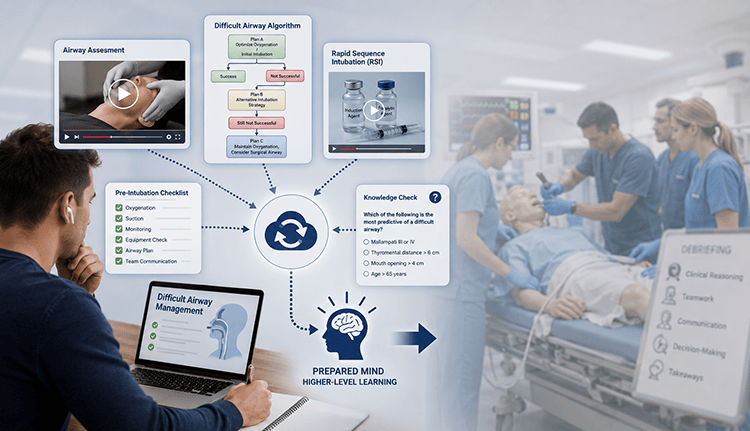
If we have learners arriving for a difficult airway simulation, for example, do we really want them encountering or remembering the fundamental concepts of airway assessment for the first time while standing next to the simulator?
Probably not.
Likewise, if the objective of a simulation is to develop advanced clinical decision-making, teamwork, communication, or application of an algorithm, we may not want the participant spending most of their cognitive energy trying to remember basic factual information that could have been refreshed beforehand.
Pre-course learning provides an opportunity to establish, or reestablish foundational knowledge before the experiential portion of the program begins.
That distinction is important.
I am not suggesting that participants need to master everything before arriving. If they did, one could reasonably ask why we need the course!
Instead, the goal is to prepare them to learn at a higher level once they arrive.
Moving Up the Cognitive Starting Line
Think about two learners entering exactly the same simulation.
One learner has not thought about the subject matter in several months. The other completed a short pre-course activity reviewing the relevant physiology, clinical concepts, procedural sequence, or algorithm a few days before the program.
They may possess essentially the same underlying education and experience, but I would argue they are not necessarily starting the simulation from the same cognitive position.
The second learner has already activated some of the knowledge that will be needed during the experience.
That matters because working memory is limited.
I have previously described cognitive load as a form of currency in simulation design. We only have so much of it to spend. If participants spend a large portion of their available cognitive resources recalling foundational information, those resources are unavailable for higher-level activities such as clinical reasoning, situational awareness, communication, prioritization, and decision-making.
Thoughtful pre-course learning can potentially offload some of that burden.
In other words, let’s not spend valuable simulation cognitive currency on something that could have been accomplished effectively before the learner walked through the door.
Adult Learners Also Like to Know What They Are Getting Into!
There is another advantage that I think is sometimes overlooked.
Pre-course learning isn’t only about content. It can also be about expectations.
I have written previously about orientation, briefing, and the learning contract that exists between simulation faculty and participants. One of my recurring thoughts on this subject is pretty simple:
Adult learners don’t like surprises!
We should take that seriously.
For someone who regularly participates in simulation, walking into a simulation center may not create much anxiety. For someone who has never participated in immersive simulation, however, the experience can be intimidating.
What is going to happen?
Am I being evaluated?
What is expected of me?
Will I have to perform in front of my colleagues?
What happens if I make a mistake?
What exactly is a debriefing?
Some of these questions can, and should, be addressed during orientation and prebriefing. But why must we wait until the participant arrives?
A short video, introductory message, course overview, example, or other pre-course activity can begin establishing the rules of engagement ahead of time. It can introduce the purpose of the program, explain how the simulation will work, describe expectations, and perhaps most importantly, begin establishing the relationship between the faculty and learner.
That means pre-course learning can contribute not only to cognitive readiness, but also to psychological readiness.
More Than Assigned Reading
There is an important caveat here. When I say, “pre-course learning,” I do NOT mean sending participants a 47-page PDF and telling them to read it before Tuesday!
We have all experienced that educational strategy.
How did that work out? 🙂
Pre-course learning should be deliberately designed just like the simulation itself.
Depending on the learners and objectives, it might include a short video, infographic, podcast, clinical case, knowledge check, interactive module, demonstration, reading, algorithm review, or even a brief reflective exercise.
Different formats also provide different pathways into the material. Some participants may benefit from seeing a procedure demonstrated. Others may benefit from reviewing an algorithm. Still others may benefit from working through a short clinical problem.
Technology has dramatically expanded our ability to provide these opportunities asynchronously and efficiently.
The key is that the pre-course activity should have a purpose.
We should be able to answer the questions:
What do I want the learner to know when they arrive?
What do I want the learner to arrive ready to DO?
Once we know that, we can work backward and ask what knowledge, orientation, or preparation would help put them in the best position to do it.
Creating Space for Higher-Level Learning
This may ultimately be the greatest value of pre-course learning.
It creates educational space.
If I can refresh foundational knowledge before the simulation, I can potentially spend less precious face-to-face time reviewing facts.
If I can demonstrate basic procedural steps beforehand, I may be able to spend more simulation time refining performance.
If I can explain the learning environment and expectations before arrival, I can spend less time getting participants acclimated.
And if participants enter the simulation with foundational concepts already activated, perhaps the simulation itself can challenge them at a higher level.
That also has implications for the debriefing.
Instead of spending the debriefing simply correcting basic knowledge gaps, we may now be able to explore why decisions were made, how information was interpreted, what competing priorities existed, how team members communicated, and how the experience might influence future clinical practice.
That is a very different, I would argue higher level series of conversations.
And arguably, a much richer one, whether you are talking about earl learners or experienced veterans!
Think of the Entire Learning Journey
Sometimes in simulation we become overly focused on the scenario itself. We spend enormous energy designing the case, programming the simulator, creating moulage, configuring the environment, and preparing the debriefing.
Those things matter.
But the simulation scenario is only one component of the larger learning experience.
Perhaps we should think more deliberately about the entire journey:
Prepare → Experience → Reflect → Apply
Pre-course learning helps prepare the learner. With knowledge, with expectations and arguable a higher level of psychological safety.
Simulation provides the experience.
Debriefing facilitates reflection and helps learners make sense of that experience.
And ultimately, we hope all of it contributes to improved performance when caring for real patients.
When designed this way, pre-course learning isn’t “homework” added onto a simulation course.
It is part of the simulation-based learning design itself.
So, the next time you are developing a simulation course, don’t just ask what participants need to do during the simulation.
Ask another question:
What could I do before they arrive that would allow them to get even more out of the experience once they are here?
You might find that putting a little educational energy into the system ahead of time helps considerably more learning flow once the simulation begins.
Prime the cognitive pump!
Until next time,
Happy Simulating!
-Paul
