Category Archives: Uncategorized

Ebola and Fidelity

hazmat_shutterstock_135522821_aThose of you who are used to my normal musings and rants against perfecting the “fidelity” and realism used in simulations might be surprised to hear me speak of examples of simulations where perfect/near perfect fidelity does matter.

Various association social forums are abuzz with people talking about simulations involving personal protective equipment in the light of the current unfolding of the Ebola crisis. It is important to differentiate this type of simulation and recognize the importance of re-creating the aspects of the care environment that is the subject of the education in the most highly realistic way available. In this case we are probably talking about using the actual Personal Protective Equipment (PPE) equipment that will be used in the care of the patient suspected of Ebola at any given facility.

This is a high-stakes simulation where the interaction with the actual equipment that one will be using in the care environment is germane to a successful outcome of such interaction. In this case the successful outcome is keeping the healthcare worker safe when caring for a patient with a communicable disease.  More broadly this falls under the umbrella of simulation for human factors.

Human factors in this context being defined as “In industry, human factors (also known as ergonomics) is the study of how humans behave physically and psychologically in relation to particular environments, products, or services.” (source: searchsoa.techtarget.com/definition/human-factors)

Other examples of when human factors types of simulation are employed are in areas such as product testing, equipment familiarization objectives, environmental design testing. So for instance if we are evaluating the number of errors that occurs in the programming of a specific IV pump in stressful situations, it would be important to have the actual IV pump or a highly realistic operational replica of the same. This is in contrast to having the actual IV pump used in a hospital for scenario focused on an acute resuscitation of the sepsis patient, but not specifically around the programming of the IV pump. The latter example represents more of when the IV pump is included more as a prop in the scenario versus that of the subject of the learning objectives and inquiry on the safety surrounding its programming.

So yes world, even I fully believe that there are some examples of simulations where a re-creation of highly realistic items or elements is part and parcel to successful simulations. The important thing is that we continuously match the learning objectives and educational outcomes to those elements included are simulations so that we continue to be most efficient and efficacious in our designs of simulation-based education encounters. What I continue to discourage is a simple habit of spending intense time and money in highly realistic re-creations of the care environment when they are not germane to the learning objectives and educational outcomes.

1 Comment

Filed under Uncategorized

Beware of Some of the Costs of Fidelity and Simulation

Fidelity is a concept that is often not thought about in detail and can contribute to being a barrier in the adoption simulation. It is also one of the most misused words in simulation, and can unnecessarily contribute to raising the costs and complexities of simulations. It can results in a significant desire to make every attempt to re-create the reality of the patient care environment without consideration of the necessity related to accomplishing the learning objectives. This has tremendous implications. Trying to overdo fidelity can cause unnecessary set up time, cleanup time, and therefore add significant costs and inefficiencies to accomplishing a simulation-based encounter. This is not to suggest tat we shouldn’t consider planning for elements that help create a more realistic presentation f what we are trying to simulate, it is just suggesting caution that each element be carefully considered for necessity and overall impact to the entire scenario including costs.BloodyMess

This set of costs is very concerning because they are in a category of what I consider add to the hidden barriers of simulation. This arises from imbedding elements of simulations in to the design that contribute to the complexity, overall costs and don’t add to the educational outcomes.

Furthermore, attempts at trying to re-create fidelity can often add confusion for the simulation participants in trying to interpret what it is that is being simulated. As I have discussed previously, there is no such thing as suspension of disbelief. Participants of simulations are constantly having to interpret their environment. Since they are engaged in a simulation they are always hyperaware of the fact that some things are simulated and some things are attempts at creating normalcy. The take-home message is that the learning objective should be carefully considered to determine what aspects of a corresponding actual situation needs to be simulated in the laboratory environment.

A careful orientation of the learner along with describing the capabilities and limitations of the simulation will engage the participant in a way that you could accomplish the learning objectives with a minimal amount of work placed into recreating the fidelity of the situation. This is particularly true of trying to re-create the environment, physical exam findings or situation that a patient is likely to be found in when compared to an actual clinical encounter.

Leave a comment

Filed under Uncategorized

Clinical Bedside Teaching Can Benefit from “Simulation Style Debriefing”

image

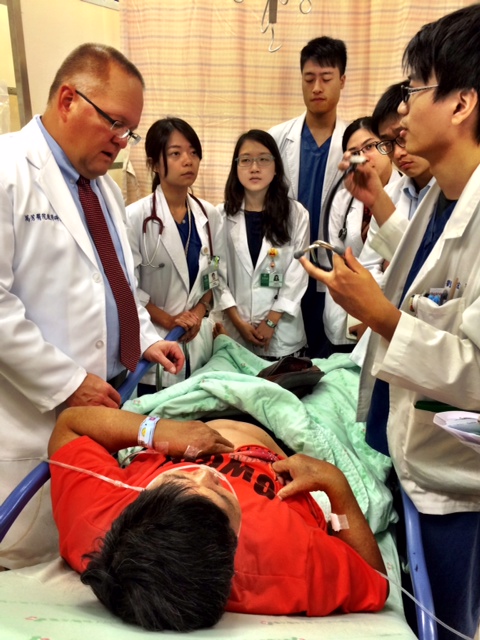
I recently had a great opportunity to do bedside teaching in the REAL Emergency Department of Wan Fang Hospital, which is one of the major teaching hospitals of Taipei Medical University in Taipei, Taiwan where I hold an appointment as a Visiting Professor.

It is amazing to realize the similarities between bedside teaching usual actual patients and the learning that can be facilitated through effective structured communications that encourage reflective learning. Yes, indeed those of you not so subtly reading between the lines recognize I am saying that I was implementing classic debriefing methods to help facilitate learning critical thought process while utilizing the experience of real patients.

We did case discussions of two actual patients with junior and senior level medical students. We reviewed case details, patient examination, hypothesis testing, clinical testing and diagnosis. During the two hour sessions I was relying upon the structured and supporting debriefing model (GAS Model) to facilitate the discussion.

The GAS model is one of the most common methods of simulation used throughout the world and was created by my Colleague Dr. John O’Donnell of WISER and University of Pittsburgh School of Nursing, Chair of the Department of Nurse Anesthesia in conjunction with the American Heart Association. 

In recent years John, I, and others have discovered the advantages of using “simulation style” structured debriefing used in the clinical teaching setting. The model encourages active reflection and self discovery through a structured model supported by supplemental learning materials and focusing on the participants readiness to learn.image[1]

Implementing the GAS Model during this exciting, but challenging opportunity to actualize bedside clinical teaching in an environment with participants who do not speak English as a primary language was hugely successful for the students judging by the feedback that I have received.

The model of debriefing can be expanded and contracting for varying levels of complexity and molded to support any learning encounters that benefit from active reflection with a goal of prompted discovery. It is easily learned through structured education sessions and workshops.

1 Comment

Filed under Uncategorized

Feedback – More Than Just Debriefing

EKG_Feedback

Too often in the designs of scenarios for simulation there is a lack of attention to the fact that there are many forms of feedback that occurs during a simulation than the debriefing. Debriefing is certainly an important part of any learning encounter, but in reality represents only one type of feedback.

As you think about sources of feedback I ask you to be both creative and attentive. I like to think of feedback in two broad categories, intrinsic and extrinsic. The latter being the more commonly thought of mechanisms such as debriefings, video reviews, and simulator log file reviews etc. with the former being the topic of this post.

What I find to be of significant interest as it related to the design of scenarios is the feedback that occurs intrinsically. That is clues, or changes that occur during the scenarios that are available to the participant to incorporate in their understanding of how their decisions, treatments, or lack thereof, are affecting the statues of the patient.

Many of you might be saying, what are you talking about???? Ha!!! Now on to my favorite part which is providing concrete examples to help explain myself further.  Let’s say you are simulating a pelvic fracture case with hypotension and shock. The vitals’ of the high technology simulator that you may be using for the case would likely show tachycardia and hypotension etc. Now lets say the participant(s) place a pelvic binding device and give a unit of blood. You may include changes in the vitals appearing on the monitor that indicated that there was mild to moderate improvement of the patient. Perhaps the tachycardia would decrease and the blood pressure may improve over a set period of time.

During the design process of the scenario many people may create the changes in the vitals thinking they are mimicking reality of what may occur.  More importantly I think those involved in the design of the scenario should realize that the changes in the vitals referred to above are a source of important intrinsic feedback. The participants should be able to make the observations and decide they are helping the patient to improve.

This can be powerful feedback that links together successful performance with particular behaviors or decisions that were made. It is self-discovery, it will help to guide further care and decisions if the scenario continues. If the designer of the scenarios recognizes this intrinsic feedback in the design phases, additional creative solutions can be implemented to reinforce the learning.

While my pelvic fracture example shows a positive change tin the patient based on correct actions, the converse example could be true if incorrect care is being rendered. Consider that if you have a heart attack case with hypotension and the patient is administered aspirin and nitroglycerin. You would likely worsen the shock from a physiological perspective. Seeing this change will provide intrinsic feedback to the learners(s).

This is not to say that it all has to do with fancy feedback from high technology simulators. The same could be accomplished with showing a worsening EKG on paper if treatment is incorrect or delayed, or conversely showing and improving EKG for the right treatment given within the appropriate time.

Approaching feedback from a deliberate perspective can be helpful in reinforcing learning. It should be recognized as a design tool and carefully integrated into the core deign of any scenario. Debriefing can be linked to these feedback areas in the scenario. This can provide valuable links or areas ripe for discussion to assist in accomplishing the learning objectives.

1 Comment

Filed under Uncategorized

Insitu Mock Codes Evaluate People Readiness and System Readiness – An Important Patient Safety Tool

CombinedTeamandEvaluationOver the last 20 years WISER has conducted hundreds of unannounced mock code evaluations at hospitals directly associated with our health system. Additionally we have assisted others with conducting and reporting on this important patient safety activity in hospitals both in the US and outside. As it is true in most things in simulation there is no binary answer on right versus wrong in the way simulation is carried out.

In situ mock codes bring a unique perspective that allows all of the effectiveness of simulation based education to be combined with human factors and systems testing that are crucial to ensure higher levels of patient safety for the increasingly ill patients who are being cared for in hospitals around the world. This is a patient population that is at well documented great risk for harm from errors that occur resulting from a myriad of causes ranging from human error to poorly design systems.

Mock codes in hospitals bring crucial insight into the care delivery that occurs episodically in high tempo, high stress unplanned situations in our hospitals. They can identify areas of deficiency that are not readily apparent. (Simulation of in-hospital pediatric medical emergencies and cardiopulmonary arrests: highlighting the importance of the first 5 minutes; Hunt et al. Pediatrics. 121(1):e34-43, 2008). We can gain unique perspectives such as where do we need to place AED’s? Is the hospital operator handling code requests in the most expedient fashion? Where in the hospital should responders respond from? It is these important system data points that can be understood from mock code data generation that are impossible to gain conclusive evidence from in the simulation lab, or in those mock codes that personnel know are of the simulated variety.

While we are able to do undeniable powerfully effective training in our simulation labs, it is the mock code and other insitu activities that help to bring true facts to factor into decisions that evaluate and ultimately improve patient safety. Do mock codes have the ability to lead to unintended harm or further error if not carefully planned carried out and monitored? Of course they do, and they must be regarded as such. But mopping the floor of the hospital also carries forth the increased possibility of hip fractures, yet it is a required element of infection control and with appropriate precautions and guidelines we make every attempt to minimize this potential risk.

Those of us in healthcare who are directly involved in the care of patients as well as those who have roles in system oversight of the direct care of patients recognize that with every intervention, every therapy and every procedure there are risks and benefits. The same goes for the training we provide. The fact that someone in a simulation center may get shocked by a defibrillator or stuck by a needle during simulation training are potential harms that may occur secondary to the use of simulation based education. So we recognize these risks through failure mode effect analysis, learning from others at meetings such as the International Meeting for Simulation in Healthcare (IMSH), remaining informed by current literature and implementing solutions that attempt to minimize these risks.

While Raemer does a wonderful job of pointing out some of the potential possibilities of potential hazards associated with mock codes (Ignaz Semmelweis Redux?; Sim Healthcare 9:153-155, 2014), this personal opinion piece does not actually include an overall analysis of risk vs. benefit. Nor does he present any data that combines evaluation of training programs, professional readiness and systems design with a quantitative deliverable that allows such an assessment. With the latter information properly collected and analyzed those of us involved in designing future care delivery systems through policy, investments in training, staffing and equipment will be better prepared to make a difference in the safety of patients.

The reference to the Owen article is baffling. (Unexpected Consequences of Simulator Use in Medical Education: A Cautionary Tale; Sim Healthcare 9:149-152, 2014). Professor Owen authored a remarkably elegant piece in this month’s SIH journal that was inappropriately titled in my opinion. The title seems to be one that attempts to be provocative in an ability to gain ones attention in the simulation world.  (That part was effective I must admit, as I read the article immediately.) However the article and its title implies that the use of simulation CAUSED untoward outcomes in patients. From a root cause perspective in the information presented in the article, that is NOT THE CASE. The poor outcomes were associated with the lack of hand hygiene and the lack of knowledge associated with proper hand cleaning and infection transmission. It is analogous to saying that an automobile striking a pedestrian is the fault of the car.

I would estimate real codes occur in our healthcare system (of 20 hospitals/care facilities) roughly 50 times per day. So if we simply take 50 codes per day that is 18,250 codes per year. This is not a rare critical event; this is a common critical event that we still have much to learn about from a training perspective as well as a systems design perspective. We all know there are delays and errors associated with codes in general. My colleagues and I reported an enormous amount of medication administration errors during observations of REAL CODES (Medication errors during medical emergencies in a large, tertiary care, academic medical center; Resuscitation. 83(4):482-7, 2012 Apr) and that is just one element in the complex environment of actual codes.

Despite reams of paper trails, and gigabytes of data in the vaults of patient safety and risk management reports in the offices of hospitals, we still have very little insight into the actual root causes of the epidemic of harm to patients that occurs during hospitalization. The mock code, with its associated risks and POTENTIAL complications is an important tool in the armamentarium of patient safety probes that will ultimately save lives.


1 Comment

Filed under Uncategorized

Is Death Not Safe?

deadSimManToeTag_aAll of the discussion on the Sim Connect Community networking site of the SSH inspired me to expound a little on the topic of death during simulation.

A number of years ago we had a poster at IMSH reporting our results of a survey given to 224 professionals (Emergency Physicians, Flight Paramedics and Flight Nurses) who attended courses that had some scenarios that ended in death depending on how the cases were managed. Overall 48% of them had experienced death during the courses. These were courses that did not include objectives on death, family/patient communications or teamwork. Thus, there was no focus on the death during the debriefing.   PDF of Poster

They were asked a series of questions about experiencing death during the simulations. The four main conclusions that we reported were: 1) Participants disagreed that simulated death was distracting to the learning environment; 2) Participants strongly disagreed that students in their respective fields should be exempted from simulated death; 3) Participants strongly disagreed that experiencing simulated death would create a reluctance to participate in further simulation training; 4) Participants disagreed that a separate disclosure about the possibility of simulated death was necessary. On further analysis there was no difference in the perceptions of those who experienced simulated death and those who had not.

Bear in mind these are all practicing professionals and all from a high-acuity emergency profession. But, none the less this was their collective opinion. So maybe at times we should slow down and ask the participants their impression. I think many people take the phrase “safe learning environment” to extremes and try to make absolute rules that are very broad sweeping and thus become rate limiting steps in creating effective education.

Do I think that death in simulation is appropriate for all learners? Absolutely not! In the case of the learners participating in the courses we studied, it was the collective opinion of the subject matter experts involved in the design of the courses that it was appropriate. But importantly, it was a deliberate decision as part of the course design.

While there is significant passion, emotions, urban myths and beliefs surrounding this topic, like most things in simulation I think there is no one correct answer. I believe that those who profess to know “THE” way to do simulation and are unyielding in there methodology or offerings should be viewed with skepticism and doubt.

When programs carefully evaluate who their learners are, make realistic expectations, understand what is needed of the learner to provide the best patient care possible, remains attentive to the general emotional well being of the participants, and deliver the learning with well trained facilitators, I believe they are providing PATIENT CENTRIC SIMULATION. A concept which I believe is the most useful of all to the global healthcare community and will result in higher quality patient care.

2 Comments

Filed under Uncategorized

Simulation: It’s Not All About Teamwork

healthcareTeam_shutterstock_71658691_a

Competent Professionals. That’s the thing that ALL health care teams are made of!

Those of us involved in simulation know that it is a powerfully, wonderful tool for educating and assessing people with regard to teamwork skills, responsibilities and communications. However that does not mean that every implementation of simulation needs to involve teamwork and communication skills.  Since the famous Institute of Medicine report came out in 1999 citing critical deficiencies in teamwork in healthcare environment and how they can be attributed to medical errors and less than quality patient care, as well as a recommendation for simulation to fill some of these gaps, many people have taken it as a mandate that simulation MUST include team training and communications. I say, Not the case.

In fact, I would argue it’s detrimental to think that way. Teams are built upon the pillars and shoulders of competent healthcare professionals. There are still gaps in educational needs in the ability to more efficiently educate individual healthcare providers, as well as provide assessment into their overall competence based on where they are in the spectrum of entry-level student to practicing clinician. While I would certainly advocate for teamwork and communication skills to be incorporated into any healthcare curriculum from beginning to end, I think there are plenty of appropriate times to ensure there is a mastery of individual competence in those goals and objectives that are surrounding knowledge, skills critical thinking and attitudes that we expect a competent professional to bring to a team.

The design and execution of the innovative education programs involving simulation has many different variables when we consider the needs of that of ensuring individual or personal confidence, versus that of a team. In fact the learning objectives would look quite different if we compare evaluating that of the responsibility of an individual person providing care, to that of the skill set that person should develop to be an integral part of the healthcare team, as further compared to the skill set that we would expect a team of professionals to demonstrate when involved in the care of the patient(s).

The detrimental part that I speak of I see far too commonly in my travels and observations of simulation efforts. There are many times when simulations are conducted that are largely designed to educate, and/or assess aspects those objectives that are largely individual in nature, such as decision-making, analysis, or perhaps psychomotor motor skills. Then at the last minute there is a design decision to include more students and literally “throw in” some elements of teamwork and her communications into the design of the scenario that ends up not being well thought out.

The end result is not hard to predict. Such simulations usually produce less than desired outcomes with regard to ensuring individual competence improvement, and are often confusing and/or inefficient with regard to being able to impart the skills associated with teamwork and communications.

So I do think that teamwork and communications, as well as team leadership skills are an important set of competencies that we need to continuously teach and evaluate across the spectrum of healthcare education and believe that simulation is one of many excellent tools to accomplish this.

However, I advocate that you proceed carefully with a well vetted list of objectives that lead to adequate scenario and curriculum design. I think you should carefully determine whether your overall educational effort is best suited for the competency of an individual, or is it largely directed towards focusing on teamwork and interpersonal communication efficiencies and effectiveness.

I do believe we can design encounters that effectively involve elements of both, but not without careful planning and forethought. In such attempts there is always a natural tension between those elements of design detail and assessment that can be applied to individual competence and those that can be applied to the team components.

Attention to these details will assist you in creating more robust educational encounters for your learners. It will also afford you better outcomes for your overall investment of time and money into your education program.

Leave a comment

Filed under Uncategorized

Simulation Can Be the Model Flipped Classroom

FlippedClassroomSimulation can be utilized in a manner that is consistent with the current recognition of the gains and benefits of “The Flipped Classroom”. Essentially the flipped classroom that many educators are talking so much about is an engagement of the students that is different than traditional models. Historically learner show up to lectures to learn about a new topic and then are assigned homework to reinforce the concepts. In the model of the flipped classroom, the students are provided with tools such as lectures, video examples, resources, reading lists that introduce the topic and allow a cognitive exploration BEFORE coming to class. Then they show up to the face-to-face activity and instead of hearing a lecture from the professor are engaged in higher levels of cognitive processing regarding the topic. These higher levels could be conducting experiments, experiential learning, exploration, group discussions debating a topic, or perhaps engaging in scholarly debate on the merits.

Imagine education surrounding a topic that involves pre-learning such as web-based education, video reviews, or other activities that either introduce a new topic or perhaps refresh the cognitive underpinnings of the subject matter. Then have the learners come together in a face-to-face environment and engage in experiential learning through simulation of various sorts that may include mannequin based simulation, partial task training workshops or content review discussions. It seems like the ultimate combination.

Interestingly, as I have been reading more about the Flipped Classroom I realize that we have been utilizing these concepts for many years in Simulation in particular with our programs aimed at training residents and practicing professionals. At my center (WISER) many of our courses are created with just that type of overall education strategy. Our Simulation Information Management System (SIMS) houses over 125 courses many which have extensive online materials for subject matter review prior to the actual simulation day. Subject materials may be pre-recorded lectures, PowerPoints, screen based simulations, videos demonstrating correct performance for example. Some courses even perform pre-tests before the actual simulation encounter to ensure that the cognitive preparation has been completed.

Intuitively it is easy to understand the advantages. The face-to-face time that students spend together in conjunction with faculty members is generally the most expensive time of the education. So it seems that we should be creating activities that maximize the effectiveness of the precious face-to-face time. Now the technology is no longer a barrier for the dissemination of information we can appeal to various learner types and styles, as well as keep the face-to-face time for much higher-levels of engagement. Thinking about it from a Kirkpatrick model we can move the reaction and learning levels to a more efficient off-site, self-paced exploration and learning, and then maximize the time the face-to-face environment with faculty to achieve higher levels of knowledge acquisition and expertise such as behaviors and results.

Image

Kirkpatrick Model of Training Evaluation

During the learning and reaction phases the learners can obtain the materials at their own pace and perhaps have a choice of methods by which to achieve the cognitive learning objectives. This increases the efficiency as learners who are mastering the material more quickly can move along to more advanced topics, and those who need a little more time, or need to review several times over have the ability to do so.

During the face to face sessions simulations scenarios can provide a deeply immersive learning environment for learners, and then this can be augmented by rich interactive discussion with faculty members as well as peers as continual mastery of the materials are recognized. The experiential learning offered by simulation can help to demonstrate the student’s mastery of the material from a cognitive perspective as well as demonstrate the ability to apply to real-world or near real world settings and circumstances.

This combination of cognitive priming or preparation with the experiential immersive process seems right to apply to the healthcare education environment. Recognizing that simulation, mannequin based simulation in particular, can be an expensive time-consuming endeavor; we need to ensure that we are maximizing the overall outcome of the educational experience.

Thus I argue simulation can be the Model Flipped Classroom and provide significant return on investment for topics that are appropriately bundled in the fashion described.

4 Comments

Filed under Uncategorized

Customer Service in Simulation – Exactly Who are the Customers?

shutterstock_138601847_aWhile of course we want to be nice to everyone who interfaces with the health care education community in reality we must allocate priorities to how we direct our resources. Many times when I am speaking in front of large group of simulation colleagues I ask the question “who is the ultimate customer of simulation program?” Often times, the audience will quickly convey to me that it is the students of the simulation program.

I share a slightly different view. While I believe that it is the patient’s AND students who are the ultimate beneficiaries of the simulation services it is actually the faculty members and those who create simulation programs that are the true “main” customers of simulation center. I come at this from a perspective of being the director of a multidisciplinary, academic simulation program that functions in a unique collaborative model in which the staff of the simulation center partner with faculty member content experts to create successful simulation based education programs that are taught by clinical faculty educators. Those educators come from various domains such as the school of medicine, the school of nursing, and various educational units of hospital systems and so on.

I remind the staff on the regular basis that the true customer is faculty who come to our facility to create learning programs, and then subsequently teach them. I believe they are the customers that our system should be designed to offer the most support to assist them in achieving their goals. At our center we continuously strive to develop tools, pathways and process, as well as new innovative ideas on collaborative opportunities to lower the barrier of participation and increase the success of the people that are here trying to create and conduct programs of education for health care providers. In the model that I have described our content experts come from a variety of backgrounds and professional domains, and most of them are not full-time simulation based educators. In fact that would be rare in our system.

Whether it is standardizing the curriculum development process, or just finding ways to assist them in the administrative needs, or perhaps assisting with the technical aspects of simulation, we stand ready to support that faculty member. Similarly, we believe that supporting the faculty members during the actual conduct of the simulation course is critically important. Being able to troubleshoot glitches, handle the “super technical” aspects that may be outside the wheelhouse of expertise of the faculty member, give the faculty member confidence in their ability to achieve her goals through simulation based education. In addition to trying to remove the workload, part of our customer service strategy is to minimize the stress of the faculty members.  

It is my belief that this extra attention of customer service effort dedicated to our faculty members5StarService and course directors directly contributes to the success of the programs that are conducted at our center. Further, it also increases the ability of faculty members to participate in continued to go the extra mile to engage students with innovative learning that includes simulation.

The net result is a proliferation of very successful programs that give great education to the participant, which is ultimately benefiting the patient’s that we here to provide care. So while the students, or participants are certainly important, the main customer is the faculty who are creating and teaching the programs.  

1 Comment

Filed under Uncategorized

My First Simulator – Good Enough?

YMCA_SimulatorMy First Simulator – Good Enough?

In 1972 I was eight years old, in the third grade, and vividly remember my first encounter with what I would call my first medical simulator at the YMCA during swimming practice. Today most would call this a partial task trainer; however I argue that that is part of simulation in the way the start of today.

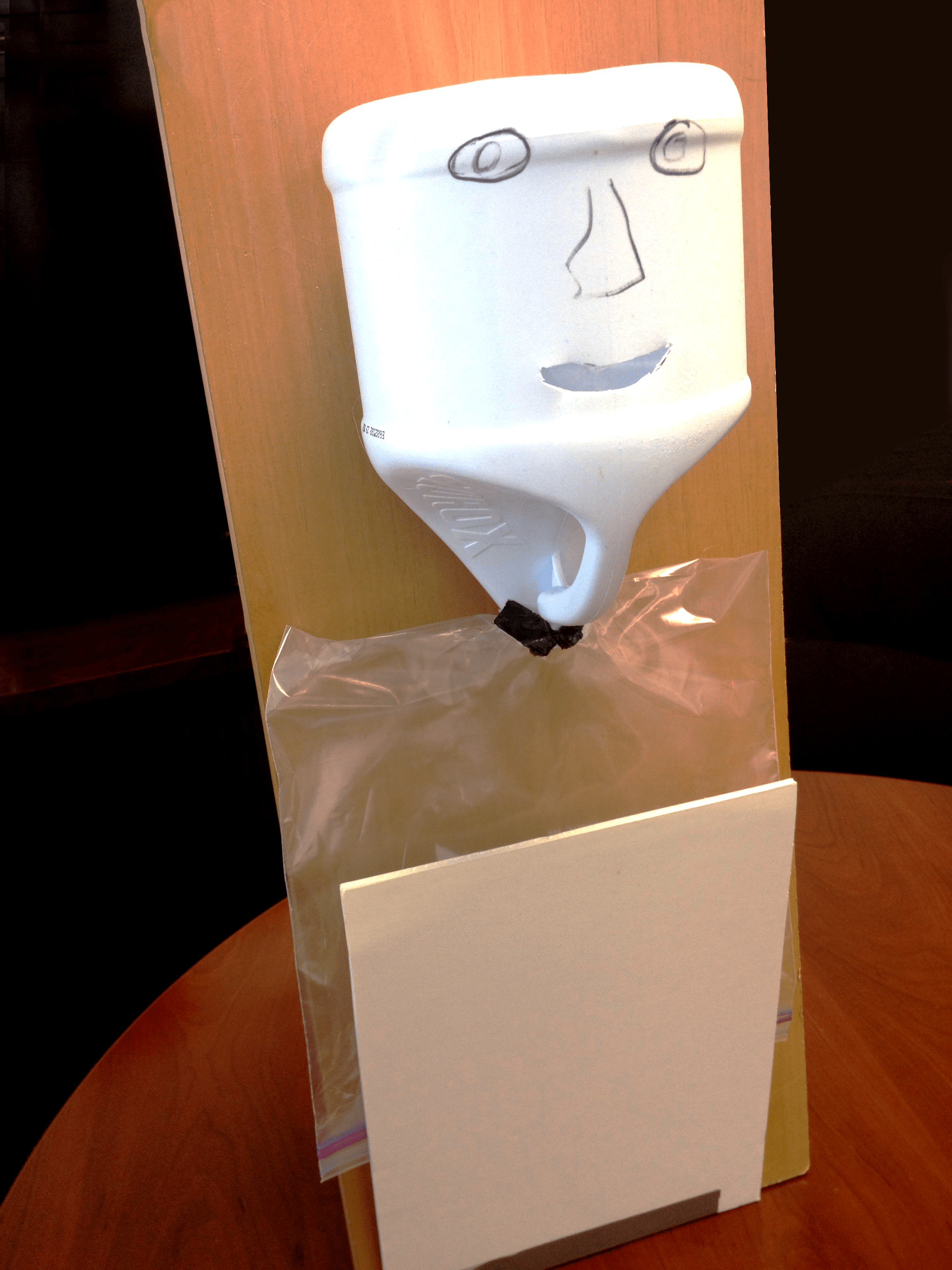
I built a replica of this simulator a few years back to present at a lecture and it appears in the picture in this post. The original was built by some clever swimming instructors who were teaching fourth graders how to do mouth-to-mouth resuscitation to save a life associated with drowning, and near drowning incidents.

It is simply a Clorox bottle with a hole cut in it, feeding into a plastic bag that would force the back of a clipboard up and down in response to ventilation’s being provided via the mouth of the Clorox bottle. See it in action here.

Crude? Perhaps. Effective? Undoubtedly! At least in my case.  High fidelity? Yep. When I breath air into the Clorox bottle, the “chest” goes up and down just like when I do ventilations on a real patient.

I keep this simulator prominently displayed in my office to serve as a continuous reminder that we are about achieving outcomes through innovative education as opposed to that of evangelism for sake of technology. While all of it has its place, I love high tech stuff as much as anybody else, there are times when simplistic models combined with enthusiastic instructors and aptly defined curriculum and learning outcomes will prevail. Prevail is a sense of sustainability and achieving long term outcomes.

This is part of the educational strategies I use join faculty development programs. The important thing is to focus on learning outcomes first, then adapt to the reality of available equipment, budget, finance and lastly scalability.

If low-tech simple solutions are the answer, then perhaps, yes they are good enough.

Leave a comment

Filed under Uncategorized