
 I recently had the pleasure of being interviewed by The Rural Monitor which is a publication of the Rural Assistance Center. They were doing a feature on a fabulous new program called South Dakota Simulation in Motion (SIM-SD) for healthcare simulation training. Talking to the reporter gave me some great enlightenment and reminders of the challenges of providing healthcare in the rural and underserved areas. It was great to hear of support for forward thinking people supporting such a great training effort to close some critical training gaps. The Article was entitled Patient Simulators Sharpen Skills of Rural Practitioners.
Category Archives: Uncategorized
Good to Hear! Simulation growing in the rural areas of the US.
Filed under Uncategorized
Running Scenarios “On-the-Fly” is Like Typing PowerPoint Slides in Front of a Live Audience

Could you imagine sitting at a lecture at a meeting and the presenter was typing the information to create the slides while theydelivered the lecture? I believe it would be maddening, particularly if the person didn’t type very well! Well folks, that is akin to what you are doing when you run your SimMan scenarios “on the fly”. Actually it is likely worse. I am writing this post in the context of SimMan because that is the system of which I have the most hands on expertise, but this story applies to almost all of the commonly available computerized patient simulators available at the present time.
Begin by asking your self, why do I create a PowerPoint to use during my presentation ahead of time, instead of in front of an audience? The answer is because you want to pre-populate, or preprogram frames of information grouped together to help your audience understand what is going on. The information that you are likely pre-populating your slides with is likely to complex, or at least too cumbersome to type out in front of the audience. In addition, you likely save your PowerPoint presentation so you can use it again and deliver the same or similar presentation with some consistency, I would ask you to realize, that this same thought process could be applied to the preprogramming of the simulator presentation during a scenario.
When you use a computerized simulator during a scenario, you are asking the participant to look at the frames of information that you are presenting to them. The individual vital signs, perhaps a sound or some other visual aid may all be part of what you want them to see. They begin to interpret your story usually in the context of a clinical situation requiring their interpretation, analysis and treatment or decisions.
As you allow the story to evolve in response to their actions or inactions, the simulator may changes states. For instance, in response to a proper treatment, you may want the vital signs to improve. Think of this as when you want to tell something different in your presentation you witch to another PowerPoint slide. Why? Because you want to present the next frame of information to the audience.
No matter where I travel in the world there is a common theme that I hear regarding SimMan scenarios. That is to say that people say “we tried programming and that didn’t work, so now we do run them on the fly.” When I ask for more details the story is usually the same. Participants always do things that we aren’t expecting and we need to “take over” is a common response. There is a feeling that when you are in a preprogrammed scenario as a simulator operator that you are trapped. Guess what? This feeling may be valid depending on the style of programming that is employed.
Also think of it from a different angle, one of my previous blog post points out the complexity of vitals sign changes that need to change during a course of worsening hypoxia. I argue that it is essentially impossible to change everything in the same way every time a scenario is run. So in essence, you lose the ability to generate consistency in running your scenarios. This consistency, or reliability is important to achieve when using scenarios as assessments.
What is the problem? The Trainees? The Operator? The Software? The Programmer? I would submit that the software systems that accompany most patient simulator these days are quite sophisticated with very deep capabilities. Most of us only learn them superficially at best. Further, those who take classes usually learn from a representative of the company who sold the equipment and there style of programming often doesn’t match reality.
Well the first lessen is participants ALWAYS do something unexpected, or at least almost always. So therefore if your scenario programming STYLE boxes you into a corner when the unexpected happens, you should change your ways, not abandon the work!
One of the best ways to get started with a comfort zone of using programmed scenarios is to use the software to create your initial set of vitals. If you think about it, just setting vitals alone causes a significant amount of task loading at the beginning of the scenario. If a patient is in shock, you would likely at a minimum, change the heart rate, pulse rate, resp rate, oxygen sats, End tidal CO2 and on and on. All of this if of course depending on the complexity and depth of clinical information you are trying to control for a given scenario.
I think of the example above every time I get to drive my wife’s car. I sit in the drivers seat and push a button labeled ‘[Driver] 2’. When I do this, the seat moves, backwards, reclines slightly, the steering wheel moves away from me and down a bit, and the mirrors adjust to where I had them previously. Brilliant! Pushing one button set so many things that I may have to adjust manually. This saves time and ensures a consistency in my experience when driving her car.
The properly pre-programmed scenario offers you quick set up (like my wife’s car), flexibility, consistency in presentation, ways to deal with unexpected, and maybe most importantly, helps allow you to observe the scenario more closely and worry about the simulator less.
This can be accomplished through an increased understanding of what the software can do, and a realistic application to your scenario objectives. Start by unlinking your changes in the vital signs or condition changes to the events playing out in front of you. Create menu items that have the simulator presentation get worse or get better, that you can trigger based on what you think should be happening based on the action or inactions of the participant(s).
Think about taking some small steps into embracing the pre-programmed scenario into your armamentarium of simulation tools. Do yourself a favor and take a simulator programming course from someone who is not a hardware company rep. Done properly, I promise you it will expand your capabilities as a simulation educator. It will also allow more flexibility in your scenario designs and increase the consistency when you run a given scenario.
Lastly, changes in the simulator condition is just part of the power of the software that you already own if you have a Laerdal Simulator. There is so much more to talk about in trying to convince you of the power that lurks inside your SimMan! I haven’t even begin to cover other technological assistance that can help with debriefing accuracy, structure and consistency, automating data collection and on and so much more!
With just a small investment in time and perhaps an adjustment to style, you can significantly boost the productivity of your Simulation program. So fear no more, take the deep dive and learn more………
Filed under Uncategorized
Simulation and the Super Bowl
 For those watching the Super Bowl today think of the amount of Simulation and deliberate practice that goes into the preparation of such a game. For those of you who are not fans of American Gridiron Football, embark on a metaphoric link to your favorite professional sport to fully enjoy this brief post.
As individuals, the craft is practiced time and time again from simple throws of the football, to more complex things such as simulated field goal attempts. Do you really think Peyton Manning needs to perform deliberate practice for accuracy with throwing the football? He does, and he is probably right. In fact he probably does it enough to make Ericsson proud.
In practice sessions team training begins when the offense plays against the defense to simulate plays. I suppose you can say they take on the role of SP’s (Standardized People).  Plays are tested and debriefed by facilitators (coaches)….. I wonder what the safe learning environment is for NFL players preparing for such a game. J
But seriously, the amount of individual as well as team practice in both psychomotor skills as well as team based skills and communications training is incredible. Rehearsal, practice, debrief, time and time again until fatigued, emotionally and mentally, is a staggering effort. All to win a game.
I wonder why we don’t do the same in healthcare.
Filed under Uncategorized
Assess-a-Phobia In Simulation – What Do We Tell the Patients?
 We need to end the terror at the thought of using simulation for assessment. I am of the opinion that one of many significant returns on investment to the healthcare community for simulation is in our ability to develop tools to help objectively assess performance. Healthcare education has evolved with a strong reliance on the knowledge base test, those that assess one’s cognitive knowledge. There is little doubt that no matter what profession in healthcare one practices a high degree of cognitive knowledge and intellectual competence are both necessary.
However, in healthcare it is important that one can apply the knowledge given the contextual circumstances they are faced to deal with when caring for patients. Simulation is evolving as an excellent tool to help provide some insight into one’s performance competence. In other words it gives us another vantage point to understand if one can actually practice and put into good use the intellectual capital that resides in their brain that was acquired through various methods of educ ation as well as experience.
Having been an educator for well over 25 years I have conducted my share of assessments. Admittedly, most of them are cognitive tests, i.e. written tests to do some sort of knowledge base  assessment. In fact, I bet most people reading this have developed some sort of written test assessment that they have given to students sometime in their career as an educator. We think nothing of creating a written test, dealing it out to a room full of students and assessing them on their ability to pass the test by whatever bar we have set as a passing score. Typically a written test has many, many items to account for the fact that variability in the testing process, variability in the interpretation of a question, as well as the fact that one not knowing a single fact should not contribute to a pass or fail on its own.
Depending on the level of stakes of the exam, we will apply more and less rigor in trying to statistically validate each item, or the test overall. Over time we become confident in our written testing instruments and use them over and over again. Eventually, we develop the confidence to say someone actually passes or fails. This can be high-stakes such as passing or failing a course, passing or failing an examination of competence that may lead to certification or other such examples.
I believe some aspects of simulation have evolved to be just as good as that bubble sheet in one’s assessment. In fact I suppose that’s not even a fair comparison because the bubble sheet is going to assess something different than the simulation. Why of course there might be overlap in what we are assessing with these two instruments but they are different tools indeed. The bubble sheet is going to best be assessing cognitive knowledge, and the simulation can be engineered to assess application of knowledge into practice.
 There is a reluctance amongst many to engage in simulation assessment activities and I am not sure why. If we think about the analogy to the written test I described above, we feel really comfortable going into a room by our self or with several of our colleagues in creating a multiple-choice written test. Why is it that we cannot go into a room with a number of our colleagues and develop some sort of assessment for simulation environment and capitalize on the advantage of the ability to observe one’s application of knowledge as described above? Continuing with the same analogy, we can then collect data over time and compare the individual items that were assessed, or the ability of the test as a whole for validity.
The origin of this reluctance is complex. In fact, the whole notion of performance assessment of humans is quite complex. However, we should not run from things because they’re complex. I think another part of the reluctance is it is a challenge to our own comfort zone. Arguably it is more difficult to give direct feedback and let someone know that they did something incorrectly, unsafe or otherwise in a face-to-face discussion as compared to letting them go to the wall where their grades are posted and see that they failed the written exam. Another piece is it takes a lot of work to design such assessment tools. But again, the mission is so critically important can’t run from the hard work.
Another part of the reluctance comes in the fact that very few of us were actually trained in the creation of human performance examinations. However if you think that through, very few of us were formally trained in the science of creating written test examinations either. Yet the comfort factor with the latter allows it to happen much more routinely.
Another way to think about it is, if you are a clinician that is supervising a trainee doing a potentially dangerous procedure on a patient is your job to give them feedback that will allow them to improve in the future. Likely some of this conversation will be reinforcing the things that were done appropriately while other aspects of the conversation will require them to make changes for the future for the things that they did improperly. So in essence, you have created an assessment!
Some will read this and argue that assessment violates the principles of a safe learning environment. I fall back on the topic of one of my previous posts, and say that we need to concentrate on Patient Centered Simulation. Likely those who argue that point are not on the front lines of healthcare and understand the need for near-perfect performance in everything we do as we do things for and to patients. Nothing is quite as disconcerting as seeing a trainee make a mistake on actual patient that has a high potential, or actually causes harm. Do we then turn to the patient or the family and say, “I’m sorry, we had the ability to assess their competency in the placement of a central line, but we thought we shouldn’t do that because it wouldn’t represent a safe learning environment.”? Seriously? I think not!!!!!
Simulation has what is so far a largely untapped capacity and capability to assist us in the journey that will make an assessment pathway to help assess competence in the newly acquired skills and critical thought process, as well as evaluation of the maintenance of proficiency and currency of knowledge, as well as application of knowledge over time.
I truly believe that it is the assessment component that will help bring the demands of simulation to the next level. It can be an important tool in the migration from time-based objectives, to a more rational system of performance-based objectives when considering things such as acquisition of practice competence, advancement in training, or even the measurement of competency in the maintenance of practice over time.
Filed under Uncategorized
Sex Sells When It Comes to Simulation
Ha! I reeled you in with that title didn’t I? Well, there is some truth to the matter. What I am describing is the sometimes dual role that we play when we are convincing people of the power of simulation. It is important that we continue this practice, but not to become confused and blur the lines of what is important and the prioritization of the same.
“What?”, you may ask, “Are you talking about?” I am talking about the fact that when we show simulations involving exciting, urgent life-threatening situations that it is undeniably sexy to watch. Nothing is sexier, in my opinion, then to see a team go in and care for a patient with arterial bleeding, or critical shortness of breath, and literally rip them from the jaws of death and have the team emerge and give feedback that the simulation training contributed to their success. This type of theatrical simulation is very common in presentations and tours of simulation efforts and programs. The adrenaline, the ease of which you can convince observers of the power of simulation through the observation of such exciting episodes of care makes it a very important tool to utilize. It is particularly important when you are trying to gain the trust, confidence and support of those who are in the capacity of funding, and/or supporting your efforts in simulation.
The part that we must keep in the back of our minds as leaders in simulation while we are putting such dramatic demonstrations of care provision on display, is that the real power of simulation is in our ability to achieve targeted learning and assessment objectives that are designed to improve the delivery of healthcare. Just how simulation gets integrated into a curriculum of training of new healthcare providers or those programs that are directed at patient safety and team training associated with healthcare systems depend upon a critical analysis, and implementation of effort in a carefully planned out way. Even the design of a scenario with the most fantastic of drama, requires toiling in the details of learning objectives, assessment objectives, curriculum integration planning as well as the technical components that make it come to life.
So while I am not suggesting that we should be trying to wow a congressperson, or potential philanthropic donor, CEO, or University Dean with a demonstration of the development of learning objectives and curricular implementation planning, we must always remain cognizant of the true mission of simulation and the things that really need to occur for it to be implemented in the most efficient, and most effective ways to achieve the desired outcomes.
Filed under Uncategorized
Suspension of Disbelief is So Yesterday – Lets Think About a Great Movie Encounter
The concept of “suspension of disbelief” was orginally attirubuted to a poet/philospher in the 1800’s with regard to creating works of fiction to be interpreted by readers. When I first started in healthcare simulation back in 1997 it was told to me that we needed to create an environment where there is a suspension ofdisbelief so that the participants will believe that they are in the actual health care environment and perform accordingly. I drank the coolaid, I thought that is what we were to do. Today when I reflect on this notion it seems a bit crazy when it is inerpreted to mean that we are designing simulations to make participants forget they are in the simulated environment.
Certainly we don’t want health care professionals to actually think they are in the real clinical environment when they engage in simulation. We want to create an evironment where they can perform aspects of what they do when they are taking care of real patients so that we can form an opinion to help them improve. This ocurrs through feedback, assessment and debriefing methods as well as other innovative learning and assessment strategies. I think we need to think of it more as a “fiction contract” which I believe was a term coined by Peter Dieckmann of Copenhagen which has always resonated with me. (At least he was the first person i heard use it in that concept,  and he a brilliant mind in simulation as well as a friend. So barring any information to the contrary, i’ll leave it attributed to him for the time being 🙂 )
A good metaphor would be to think of it more like the intellectual engagement of going to see a great movie. The movie goer buys a ticket and enters into a contract (of sorts) with the producers of the film and perhaps the movie theater involving a belief that the money they are spending will allow them to see something that is not quite real, but is a reenactment of something real, and perhaps they will be participating in it emotionally and psycologically, but they never thought it was real. However, the value to the participant is in the movie metaphor would be the entertainment provision. So in essence the “deal” is summarized by the fact that they are entering into an unofficial agreement that says I will provide you $15 to buy the movie ticket, and you will provide me two hours of entertainment.
I think there are strong analogies between that and the way we should approach healthcare simulation relationship between participants and the simulation providers. We need to create environments where the participants trust us so that they will engage psycologically and emotionally in the simulated environment in exchange for the valuable use of their time to help them improve as a healthcare provider.
I think that if we shift the focus so that we are not trying to create a “suspension of disbelief”, it will allow us to better create the environment necessary for effective healthcare simulation. That is that we realize we’re not trying to recreate everything to do with reality in healthcare, we’re just trying to recreate that which allows the participant to engage in a way that they might when they are actually taking care of patients. I think it is particularly important to be direct in letting the participant know that not everything we do in simulation will mimic their realistic practice environment. If we are honest with this orientation and apporach, I believe it causes less constrenation on the part of the participant who is in an environment where some things seem real and some things do not.
Participants are often experiencing a sense of internal “conflict” when interpreting what the see, hear and experience in the simulation, wondering is this supposed to be part of the simulation or not? I am of the opinion that they are more likely to reconcile this with us if we are frank, open and honest about the intent and expectations of the simulation. This is in contrast to simply asking them to “pretend this is all real” conceptually describing the mantra of suspension of disbelief.
Through this bilateral agreement we enter into a fiction contract or a trust contract that says, on the participant’s side, I will engage in this activity in exchage for the trust that you are making valuable use of my time and helping me become a better healthcare professional. On the simulation provider side of the agreement it goes something like this: “we will create an educational program using aspects of simulation, which some parts will feel realistic and some will not, but we commit to you that this will be a valuable use of your time with tust, dignity, respect and professionalism. We will attempt to help you get better as a healthcare provider.” Isn’t that what we’re all trying to accomplish? To me this seems more plausible than asking professionals to suspend the disbelief and interpret the entire simulation as “real”………
Filed under Uncategorized
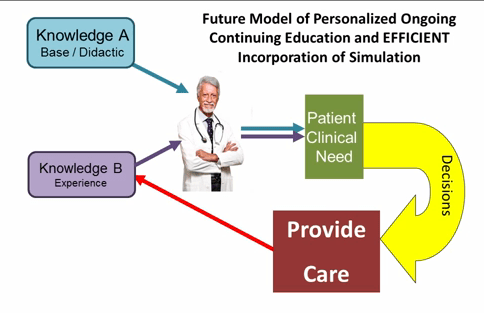
Simulation and the Future of Customized Continuing Education for Practicing Professionals
Click Here to Watch the Video on YouTube
I posted a new video on the WISER You Tube channel describing how simulation can fit into a futuristic model of customizing a pathway of continuing education for practicing healthcare professionals. The model incorporates the utilization of healthcare system quality, safety and risk data. A provocative thought to move us down a road to help imoprove replace the time honored, yet inefficient system of continuing education that exists currently.
November 13, 2013 · 7:50 pm
Patient Centered Debriefing – The Ultimate Goal
I am growing more and more concerned about the pacifism by which I hear people approaching their debriefing efforts as I travel about the world. The phrase “safe learning environment” is being hijacked into some sort of process during which the only thing that matters in the world is the feelings of the learners participating in the simulations. So much so that some are saying you shouldn’t tell students what they didn’t do correctly and that during debriefing you should only focus on that which went well and then have a group hug at the end. This is being claimed under banners of student centric debriefing, “safe learning environments”.
Do these same educators harbor the fear and trepidation that students might be sad if they perform poorly on a written test? Do these same educators realize what a disservice they are doing for the students when you step back and look at the big picture? Maybe the educators themselves have a tough time bucking up and delivering the news, doing the HARD WORK of simulation. Perhaps, this shifting or trending is partly evolving because many of the people involved in the teaching and theorizing about simulation feedback don’t see patients on the frontline of the healthcare battlefield.
I am certainly not advocating that we don’t need to be mindful of students emotions and psychological well being during simulation education activities, but come on people, healthcare decisions and actions involving patient care need to be near perfect. Every Time. We need to be certain that when participants leave our simulations they have a clear understanding of what was right and what was wrong not just do a deep dive into their feelings carefully guarded by the emotions police and find happy things to chat about.
I am sorry to be the bearer of bad news, but providing healthcare is hard work, stressful and requires excellence. We need to develop/reinforce excellence in the participants of our simulations and help them achieve their goal, which is to get better at what they do. Every healthcare professional in the world has this as a goal at some level. How we reach out to them and help them along this journey needs to be PATIENT CENTRIC because the ultimate goal is to continuously improve healthcare throughout the world.
We certainly must develop methods consistent with the levels and abilities of our simulation participants and create environments that are open to participating, learning, exploring and discussion. But we also must provide participants with information on where they are with regards to expected performance on a continuum of the development of competence. We can not hide the truth during a debriefing because the faculty is uncomfortable with delivering critical feedback, or is so concerned that the students emotional fragility will be violated if they receive the feedback. This is a violation of our ultimate relationship with the ultimate beneficiary of healthcare simulation, the patient.
During debriefings it is incumbent upon us to make sure that students are treated fairly, treat each other fairly and help to discover things needed for improvement through creating reflections on the learning activities. We also need to make sure there is crystal clarity on expected outcomes versus perceptions of performance that are reconciled. We also must guide the debriefing process in a way that is mindful of the psychological safety of the involved. I think this can be done with adequate training, re-training and continuing practice with the art of debriefing. When we achieve this, we have arrived at Patient Centered Debriefing, and that’s a place I think we all want be.
I do believe most professionals want to know what they did well as well as what they didn’t. They are the fundamental elements of being able to reflect and improve. We need to be able to have the message delivered by either a process of self-discovery, perhaps through facilitated reflection, or at other times, but just directly providing the information. This doesn’t mean it has to be harsh, or without the feelings of the person involved carefully considered, but it does mean it has to happen with a level of deliberateness that is unequivocal. It is the true art of the debriefing to be able to lead this effort and achieve these goals.
Finally I’ll close with a quote from my twelve-year-old son about one of his baseball coaches, “Dad, why does coach always tell me I did a good job when I know I messed up?” What is the answer? Not sure, but I hope that the coach doesn’t change careers and become a simulation facilitator for healthcare professionals.
Filed under Uncategorized
Fun Stuff, Details and Blooms Taxonomy – Considering the Outcomes for Improved Learning Encounter Design
While I am the first to snooze (with drool) when people at adult education classes mention Blooms Taxonomy, the details of what is trying to be accomplished during a learning activity involving simulation should be thoroughly sorted out to allow for proper design decisions. Today I will use central insertion as the case in point example.
One of the challenges when creating educational encounters for people is to truly break down into small pieces what we are setting out to accomplish. This is an important early task in trying to create an effective educational encounter that may involve a hybrid of technology or learning modalities. Classifying the learning into knowledge, skills etc. at a fairly detailed level will help us to make good choices with regard to design.
Practicing clinical providers who are also working as educators need to pause and think of things in a very stepwise fashion. For example, as a competent Emergency Physician I have the ability to walk into a room evaluate a patient and the surrounding data and decide that the patient needs a central line placed. I also have the skills to perform the procedure (which also has important cognitive as well as psychomotor components).
In the design of a simulation of the same patient described in the last paragraph we must remain cognizant of the fact, that as an experienced emergency physician the recognition of the need for the central line and the requisite ability to safely put is seemingly a simple connected situation. This is a situation that occurs routinely when I am working in the clinical department of my hospital. However when creating a learning encounter involving simulation I must stop and realize that the skills to evaluate a patient and recognize that a central line is needed as part of the treatment plan, is DISTINCTLY different then the skills and knowledge needed to place the line.
Again, we must be careful that our simulations do not seek to recreate reality per se, unless we are sure that we want the reality re-created. This thoughtful consideration approach our learning encounters can be designed in a way that maximizes the time and resources in a most efficient, but also effective way.
The implications are huge. If your true learning objectives are to evaluate the ability of a person to place a central line safely and you create a “big” scenario of a decompensated patient in Diabetic Ketoacidosis to do it, you are wasting considerable time and effort, as well as taking the focus away from the line placement objectives. Further, you run the risk of the participant not making the proper diagnostic evaluation, and/or missing the fact that the patient required a line. Should that occur, you miss the opportunity to evaluate them placing the line. This is what I call dependent learning objectives. (not a bad thing, just needs to be recognized)
If your objectives also include identifying the fact that the patient needs a line, then by all means create the accompanying scenario, but at least you have made a thoughtful decision on how to create the opportunity to allow you to evaluate the objectives that you are setting for the learning encounter.
Lastly I will conclude with a reminder that all procedural skills have associated cognitive learning objectives and they should be accounted for in the designs of your scenarios. Too many times participants engage in task training of the psychomotor skills of the procedure at many simulation centers around the world and then are expected to learn the cognitive part by osmosis. Or perhaps they were shown a series of slides at the beginning of the workshop quickly before they were “getting on to the fun stuff”. This leads to significant problems downstream with implications on patient safety, the ability to teach others, as well as the capability to properly process and make decisions when things don’t go as planned.
So go forth and plan your educational masterpieces, but consider the principles of a detailed recognition of what your trying to accomplish!
Filed under Uncategorized
Beware of Rule Club – Your Simulations Must Fit Within Your Operational World
 How many rules have been vetted in the literature with regard to how simulation should be designed and conducted? The answer? (drum roll, please……..) Not many. This is an important point to consider when making the decisions that are part and parcel to you creating successful simulations. Healthcare simulation can take on many forms including designs for pure teaching activities through assessment activities, covering a broad range of objectives or simply a few. The bottom line is there are many ways to do simulation correctly.
One of the first things to be aware of is that you must start with the end in mind. Ask yourself what you really want to accomplish. And by the way, I’m not talking about the simulation. The simulation is actually the means to get to what you want to accomplish. Hopefully! What you a want to accomplish is ensuring that the healthcare providers who complete your learning and/or assessment activity are likely to provide better healthcare in the future by way of increasing their confidence and competence in what they do.
Common rule club fallacies include imposing some magical formula on the length of the debriefing as related to the length of simulation, demanding that you must use video review, demanding that you must design your simulation to mimic real healthcare, demanding that you must use the highest technology available, demanding that you must conduct your simulation in an environment that is as real as possible, demanding that you must debrief in a different room than where the simulation took place, demanding that you must not let the simulator die and on and on and on…… Bunk….. it’s all bunk.
Trying to follow all of the rules of rule club will just slow you down, impede your ability to reach your goals and make you sit around and wonder why you didn’t accomplish what you set out to do even though you were working so hard. Worse yet, it might even make your boss think that you can’t get enough done.
Are their best practices emerging, is there some science to guide us? Absolutely! Just not much! We know we must provide a safe learning environment, provide feedback that usually will include a debriefing (but maybe not always). But there is no secret recipe hidden on the planet that you will be able to receive at a meeting and go home to bake a magical, successful simulation cake.
Your job however is to try and sort through the best practices, read the science that is available, learn from others, learn from people like me who teach all of the time at workshops, symposiums and conferences. But THEN you must go home and figure out how to design your efforts that fit in the operational constraints that fit your situation. Such constraints may be related to budget, personnel availability, equipment, space or other factors to name a few. Some may be the amount of time that you can actually have access to the participants (this is particularly true if you are working with practicing professionals as your normal learner group.)
So in summary, envision and brainstorm with the end it mind. Then take all of your accumulated knowledge of the science and best practices as well as the information you get from others and make the program fit your realities! Do this non-apologetically, collect data along the way, and you will find yourself becoming much more productive then if you are trying to follow a specific recipe of rule club who tend to stand atop the mountain and issue commandments to make you feel guilty if you don’t follow them!
Filed under Uncategorized